Showing posts with label Night Shade Books. Show all posts

14 April, 2015

Guest Post - Betsy Dornbusch on "Writing Sequels"

I'm happy to have Betsy Dornbusch on the blog again (see her article on the Writing Process). She's here today to talk about writing sequels, as I guess you may have guessed from the title of this post, you clever devils.

And Betsy would know all about writing sequels as the sequel to her debut, Exile, just came out last week - Emissary:


Here, she takes us into the writing process once again and looks at what it's like going back to the world she created in the first book.

________________________

Writing Sequels
Betsy Dornbusch

            Writing a sequel is a really big topic because Emissary is such a big book (for me, anyway). At a 140K words, it’s bigger than Exile by 50%, and the book is a sort of trilogy all on its own because it’s sectioned into three parts: Draken in his new home, Draken traveling to his old home, and then back to his new home in a mad dash to defend it against invasion.

            The world of the Seven Eyes is also a big one, but I think you don’t get the sense of just how big it is in Exile. Draken, exiled (duh), doesn’t think too much about his old home except in comparison to the  new one. He’s still in shock from all that happened and dwelling on memories isn’t conducive to staying alive. His new country, Akrasia, has little to remind him of his old, Monoea. It isn’t an old country, nor is it crowded. The biggest Akrasian city isn’t a quarter of the size of Sevenfel in Monoea, the one Draken grew up in. And shifting from a nation of single ethnicity in which he is an outlier to a melting pot kingdom where he actually fits in without much trouble is a big enough adjustment for one book.

           At the start of Emissary Draken is about as recovered from the trauma of being exiled as he’s ever going to get (he suffers from depression). But when soldiers from his old country invade and demand he return home, he knows it means certain death. Unfortunately, they’ve got more than one secret to hold over his head. Going back is a selfless act; his queen, a child on the way, and the well-being of his country are all at stake. But when he gets to Monoea he realized the leaders there have even bigger concerns.

            The plot isn’t at all straightforward, either, and lends itself to some sprawl. There are too many factions with opposing goals, and we only get a limited picture of each with the entire story being in Draken’s point of view. Plot points in the story, as was noted in an early review, tend to fold back on themselves. I guess it’s natural; the whole story is one of Draken having to fold himself back into his past. In a way, Emissary is two stories: one of the present day and one of Draken’s past.

            Such a big story has myriad subplots: love interests, relationships gone askew, running jokes, a cast to keep track of, and an ever-growing body of magic. I found the magic the toughest to manage, because I had to one-up Exile. I knew in each book Draken would be gifted magic from the gods. Draken is a believer but not faithful, and he doesn’t view any of it as much of a gift. He has a tendency to turn his magic on people he shouldn’t and use it in ways the gods never intended. When they give him a necromantic sword in Exile, he has mostly disdain and then uses as a mere tool, ignoring the gods’ favor that comes along with it until forced.

           A minor spoiler for Emissary, one I feel comfortable sharing because it’s on the first page: Draken becomes self-healing. This could be a small, limited gift, but the way it manifests is not. These are big gifts: a sword with the power to give death and life, the ability to heal oneself. Really, they’re as big as the story itself. Keeping the magic in consistent use with a growing tension was one of my biggest challenges in writing this sequel.

            And then of course I’ve spent a lot of time working out how Emissary informs the last installment of the Books of the Seven Eyes. Draken emerges from the sequel cleansed of his old past but saddled with new truths and damage. Fortunately, I tend to plot. That helps.

           A trilogy is an intimidating project. I found writing the bridge piece, the sequel, a major challenge. A sequel does more than further the overall story arc, it has to lead to the next book, increase stakes and tension, grow the characters, but not finish them, and yet leave the readers satisfied they’ve read a complete story with its own subplots and resolution. But it has its advantages, too. The world is mostly established, though we might get to see more of it. Characters are developed and relationships can be deepened rather than launched. There’s a definite satisfaction in returning to beloved worlds. I hope you enjoy returning to the world of Seven Eyes as much as I did.

________________________ 


Bio:
Betsy Dornbusch is the author of several short stories, novellas, and novels. In addition to speaking at numerous conventions and teaching writing classes, she has spent the last decade editing the online magazine Electric Spec and writing on her website Sex Scenes at Starbucks (betsydornbusch.com). She and her family split their time between Boulder and Grand Lake, Colorado.

Links for ordering Emissary (Seven Eyes, Book 2):


09 July, 2014

Guest Post - "Writing Process" by Betsy Dornbusch

I’m asked about process a lot on panels. I get it. People want to know what works, how writers get words on the page. What’s the password to the club? What’s the secret handshake? Is there an elixir? I heard there’s an elixir!!

We’re all granted the same hours in a day but some writers just seem to get more stuff done in less time. I tend to be a slower writer but I generally get more done per pass than others. The idea of doing seventeen passes on a book... ugh. Never. Again.

But I’m getting ahead of myself.

The longer I write, the more I plot. Tagline, flap copy, and synopsis—yeah, just like the market wants. It’s how I toss ideas into the lake to see if they float or swim. I do take them public sometimes, or ask friends. It’s worth it to test salability of ideas, and I’m not precious about them. If there’s an easy part of the process, it’s ideas.

My taglines are usually simple for personal use while it’s a WIP. When it was Exile, it was “Falsely accused for murdering his wife, a middle-aged soldier is exiled to an enemy country.” Last year, when I was working on the sequel, Emissary, I said, because lots of people know what Exile is about,“Draken has to go back to his original country to face a death sentence and a religious revolution.” And now, when I’m working on Enemy, I tell myself, “After a divisive coup Draken has to cobble his country back together to defeat foreign invaders.”

The next thing I write is basic marketing copy. Nothing too fancy, a basic paragraph. A few tent pole scenes, and the climactic cliffhanger with a little internal conflict/motivation thrown in. I’m pretty dependent on this paragraph. I don’t start writing a word until I’ve got at least that much because if it doesn’t read well that means the idea sucks.

I used to totally pantz it. Writing wasn’t FUN unless I didn’t know what was going to happen next. But you know what’s not fun? Rewriting a pantzing disaster. After a couple of these, I decided to remake myself into a plotter. I trained myself to brainstorm with friends and synopsis. At first it’s something like a couple of pages. A list of tent pole scenes, again, but more embellished, and I work harder at motivation. Why does this matter? Why doesn’t s/he just walk away? Why is my character re/acting the way s/he is? What’s the starting point, how does that inform the action, and what’s driving my character to point Z? What’s the worst thing that can happen? I include some internal conflict and drum up as many obstacles as I can. This is an anything-goes time, but I’m trying to work myself to an ending so I know where I’m headed. I’m also drafting during this time because I have no self-control. Also I do rolling revisions while I draft, going back and fixing things.

For my next book, Enemy, which completes the Seven Eyes Books, I’m working on my most detailed synopsis yet. It’s nearly chapter by chapter, though I haven’t designated any in my synopsis. It currently sits at five thousand words and I fully expect to add another thousand as I revise it. There’s a subplot to weave in and a twist to the ending I’m thinking over.

Not all publishers want this. Some want a treatment—a one pager, basically. Some do it on a verbal conversation. But I know to write the book in a timely fashion, I need this level of detail to keep me going from day to day.

And yeah, day to day. Hmm. The process there sometimes falls apart. I have kids in school, a dog, a husband, and a house to keep. I’m still working on my daily process and I think I’m realizing every day is different. I used to write to a scene, but now I tend to write word counts. I’m not sure which works better, though I feel like word counts make me more accountable (literally—haha). As I said before, I’m a pokey drafter, turning out pages as clean as I can make them.

Right now I’d call Facebook my biggest disruption, mostly because it’s the new email. Most of my writer friends contact me via PM. It’s how we organize conventions, appearances, everything. I’m in a few private groups of writers, some public interest groups, and there are always other friends to keep up with. Honestly, I’d dump Facebook if it wasn’t so integral to communicating with fellow writers. Twitter I spend less time on because every time I click it, I start chasing links and getting into conversations. I find it to be more of a timesuck than Facebook, which simply doesn’t move as fast. Twitter is probably one of those things I should be doing more, promotions-wise, but I try to put the majority of my work-time into writing.

I think the biggest part of the professional writing life is that there’s always more to do. It’s overwhelming, which is why I think some writers (coughmeahem) fall down on the day-to-day end of things. If we start thinking macro instead of micro, novel instead of chapter, or even scene, the job quickly overwhelms us.

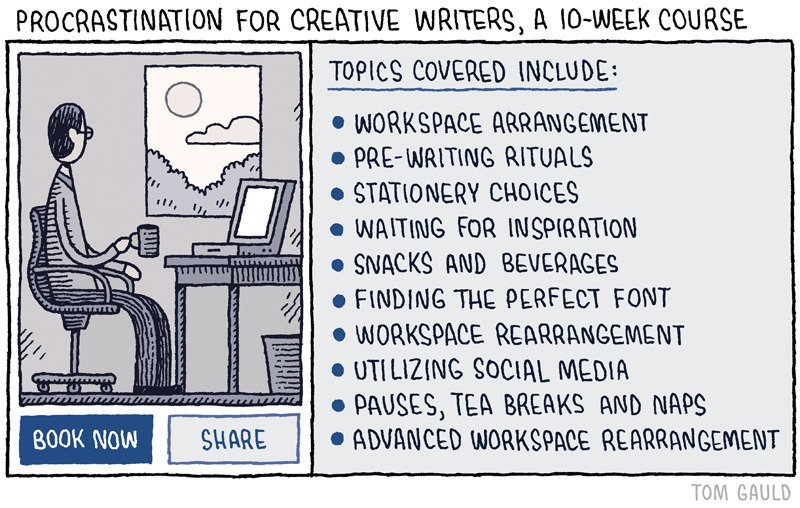
Then we start to procrastinate. This

Source: http://myjetpack.tumblr.com/image/80457780970
cartoon from Tom Gauld pretty much describes my efforts therein. I’ve never actually been blocked but I have been too twitchy to write. That’s when I know it’s time to get up and do something else. Usually cleaning toilets or pushing the vacuum gets me back to telling stories quick enough. And that, Charlie Brown, is what writing is all about.

--------------------------------


Betsy Dornbusch is the author of a dozen short stories, three novellas, and two novels. She also is an editor with the speculative fiction magazine Electric Spec and the longtime proprietress of Sex Scenes at Starbucks (www.betsydornbusch.com).


Check out Exile, published by Night Shade Books, at Amazon and Barnes and Noble.

05 May, 2014

Giveaway Winner! Deadroads by Robin Riopelle


Looks like it's about time we announce our winner of the Giveaway for Deadroads by Robin Riopelle. Deadroads just came out from Night Shade Books, who are known for pushing boundaries and taking chances and new and interesting stories. Deadroads looks like no less. Without further ado...

The Winner is:

Lisa from White Plains, New York!

Thanks to all who entered and we look forward to seeing you back for the next.

Also, check out Robin's awesome Guest Post on language in fantasy.

15 April, 2014

Giveaway - One Copy of Robin Riopelle's Deadroads

Robin Riopelle was not only kind enough to provide our humble blog with a guest post not too long ago, but today I'm hosting a giveaway for her debut novel, Deadroads.

The Sarrazins have always stood apart from the rest of their Bayou-born neighbors. Almost as far as they prefer to stand from each other. Blessed—or cursed—with the uncanny ability to see beyond the spectral plane, Aurie has raised his children, Sol, Baz, and Lutie, in the tradition of the traiteur, finding wayward spirits and using his special gift to release them along Deadroads into the afterworld. The family, however, fractured by their clashing egos, drifted apart, scattered high and low across the continent.

But tragedy serves to bring them together. When Aurie, while investigating a series of ghastly (and ghostly) murders, is himself killed by a devil, Sol, EMT by day and traiteur by night, Baz, a traveling musician with a truly spiritual voice, and Lutie, combating her eerie visions with antipsychotics, are thrown headlong into a world of gory sprites, brilliant angels, and nefarious demons—small potatoes compared to reconciling their familial differences.

From the Louisiana swamps to the snowfields of the north and everywhere in between, Deadroads summons you onto a mysterious trail of paranormal proportions.
If you'd like to win a copy of Deadroads by Robin Riopelle, published by Night Shade Books, just follow the exceedingly simple instructions below:

- Email your name and address to onlythebestsff@[remove this]gmail.com
- Use the subject line: "Dead Roh-ads" (Think Black Sheep)
- Duplicate entries get you disqualified
- Snarky comments increase your chances of winning by giving you double entries for the next giveaway

I'll post the winner in a week or so and good luck!

31 March, 2014

Guest Post - Robin Riopelle - "It's High Valyrian for 'Culture'"


Robin Riopelle is the author of Deadroads, the latest from Night Shade Books, which comes out tomorrow. I'm extremely excited to have her on the blog today, discussing a very important aspect of fantasy ... language. If done right, language can add such depth to the fantasy world and it's been a focus of many authors from Tolkien to Delaney. It also plays a key role in Riopelle's novel, so without further ado...
_______________________

Valar morghulis: It’s the tagline HBO is using to sell the new season of Game of Thrones. Who knows what it means? Hands, everyone. Thanks. Yes, all men must die, that’s right.


See what I just did there? I used a fictional foreign language, and I almost immediately provided the translation. That way, you weren’t too annoyed if you didn’t know or remember what the hell those words meant (though given HBO’s relentless marketing campaign, I’d be surprised if you didn’t). If writers drop in foreign phrases without unduly pissing off the reader—particularly words from a language they’ve gone to the trouble of making up—it’s a convenient way to convey the rich complexity of a particular people.

At a bare minimum, language adds atmosphere. Taken at its deepest point, language underpins the very fabric of culture.

There’s a good reason passels of cultural theory folks* have had a whack at dissecting the role of language in the formation, development, and retention of culture. Simply put, language is culture. It’s why languages other than English** should be protected and supported, especially in places like French Canada, and among aboriginal communities. Loss of language is a precursor to loss of identity.

For writers, constructing a new language (a conlang) or weaving in an established one, allows an entry point into the values and beliefs of the people they are writing about. Imagine if the Lothlorien elves spoke English all the time, or if we never had the pleasure of hearing Daenerys mangle the dour Dothraki vocabulary. Our world would not be a richer place.

In my novel Deadroads, the main characters have a Cajun father and an Acadian mother. The French phrases and syntax that occasionally surface reflect these roots, are part and parcel of cultural identity and the characters’ sense of belonging. Lutie, the sister fostered away from her family, grew up without the language, and her inability to speak in the cadences of her brothers hampers her efforts to connect.

The use of actual non-English languages in fiction is established and not without its critics. The Guardian’s Daniel Kalder plaints that the use of untranslated foreign words is a “cheap bus ticket to bogus exoticism.” Tell that to Ernest Hemingway, or Cormac McCarthy, or Vikram Seth. Hell, tell it to Anthony Burgess and Irvine Welsh.

The omission of a non-English language would be paramount to ignoring it. Worse, to assimilating the people that speak it, to steamroll their unique words and associated culture into the mainstream tarmac.

Other critics feel that the use of a language other than English is distracting, confusing, and distancing. Unbridled, the language runs amok, destroying plot and overturning the narrative furniture. Myself, I’m pretty happy not to be spoon-fed. I don’t mind puzzling out the language when the author’s given me enough context, and my friend the Internet is usually just a click or two away anyway.

Where language goes, the rest follows. Guy Gavriel Kay is aware of this, at no time more poignantly than in his wonderful novel, Tigana, where an entire nation is dispossessed not only of its land, but of the very name of their land. They can still say the word—the title of the book—but no one not born there can hear it. Their past, their very identity, has been made less, rendered null.

It’s a terrible reality for many people(s): the aboriginal children of residential schools, beaten if they spoke their native tongue; new-arrived immigrants, desperate for their children to assimilate, losing them when they can’t speak the same language anymore. I can pin the time when French left my family: my grandfather spoke it fluently, but his wife forbade him from passing it along to the children, even going so far to Anglicize the family name.

Reclaiming language once it’s gone isn’t easy, but not writing of it at all is worse.

______
* Foucault, Bourdieu, Barthes, Chomsky, etc. – take your pick, they’ve all written about language and culture. A handy starting point would be the Routledge Language and Cultural Theory Reader.
** In Western culture, particularly North America, English is the dominant language and is arguably pretty robust. This in no way demeans or negates the efforts of organizations such as the Apostrophe Protection Society or every grammar nerd ever born.

______________ 

Twitter: @Robin_Riopelle
______


22 December, 2012

Night Shade Books - Free Downloads Yet Again! AND eBook Deals

This nice combined image stolen from Civilian Reader.

I can't help it, who doesn't love free books? The word must be spread. Night Shade Books is giving away three more books in celebration of averting the Mayan prophecy.
Email StillHere@nightshadebooks.com and you'll receive an auto response from us with a username, password and link to our download site where you'll be able to download the .epub or .mobi files of some of our most exciting and appropriately apocalyptic titles...
Like I said last time, give Night Shade Books a try. They've made up for past mistakes, it's time to forgive and forget and read amazing books.


In other eBook deals news:
[$3.99] 11/22/63 by Stephen King
[$0.99] Dragon Haven (Rain Wilds #2) by Robin Hobb
[$1.99] Out of the Silent Planet (Space Trilogy #1) by C.S. Lewis
[$1.99] Perelandra (Space Trilogy #2) by C.S. Lewis
[$1.99] That Hideous Strength (Space Trilogy #3) by C.S. Lewis
[$0.99] The Shadowdance Trilogy by David Dalglish - The entire trilogy is contained in one, nicely priced download.


Today Only:
[$1.99] Prince of Thorns by Mark Lawrence - Excellent debut. See my review. The sequel, King of Thorns (my review), is also excellent if not more so.

03 December, 2012

Interview - Courtney Schafer, Author of The Shattered Sigil Trilogy

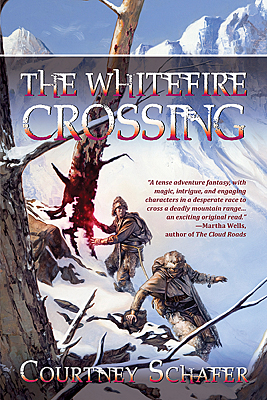
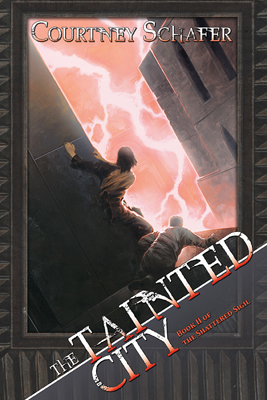
Courtney Schafer has become one of my new favorite authors with her debut series, The Shattered Sigil. She exploded on the scene last year with The Whitefire Crossing (review) and followed it up this year with a sequel, The Tainted City (review), that was just as good if not better. While I had no idea what to expect going into TWC, I was immediately charmed and would even go so far as to say it was my biggest surprise of last year. You can imagine I'm looking forward to read more of what Courtney has in store and the conclusion to this trilogy will be no less than stunning I'm sure.


If you're unfamiliar with this series, following is the description of the book one, The Whitefire Crossing:
Dev is a smuggler with the perfect cover. He's in high demand as a guide for the caravans that carry legitimate goods from the city of Ninavel into the country of Alathia. The route through the Whitefire Mountains is treacherous, and Dev is one of the few climbers who knows how to cross them safely. With his skill and connections, it's easy enough to slip contraband charms from Ninavel - where any magic is fair game, no matter how dark - into Alathia, where most magic is outlawed.

But smuggling a few charms is one thing; smuggling a person through the warded Alathian border is near suicidal. Having made a promise to a dying friend, Dev is forced to take on a singularly dangerous cargo: Kiran. A young apprentice on the run from one of the most powerful mages in Ninavel, Kiran is desperate enough to pay a fortune to sneak into a country where discovery means certain execution - and he'll do whatever it takes to prevent Dev from finding out the terrible truth behind his getaway.

Yet Kiran isn't the only one harboring a deadly secret. Caught up in a web of subterfuge and dark magic, Dev and Kiran must find a way to trust each other - or face not only their own destruction, but that of the entire city of Ninavel.
This interview delves mostly into the writing process and some very peripheral questions about magic and the world that . There is only one question that even asks anything about the third book in the series, but for the most part this interview is spoiler-free.
--------------------------------


1. Let’s get to the important stuff right away. If the nominees in this last election were mages in Ninavel, what type of mages would they be?

Ha!  Always great to get a question no one's asked before. :)  As for the political nominees...they'd be middling mages of no great talent.  To quote Ruslan in The Tainted City, "Some men confuse magical power with the more mundane sort...Lesser mages are particularly prone to this error.  When they reach the limits of their talent, they often turn to the accumulation of wealth, or seek to reign over the untalented, as if that makes up for their lack." 

2. What got you in to writing? What self-respecting electrical engineer becomes a writer? Didn’t your parents teach you any better? J

My parents certainly tried.  I remember when I was at Caltech, I once considered switching majors from electrical engineering to geosciences. Volcanoes and earthquakes are cool, and besides, the geoscience students go to tromp around Death Valley as part of the classwork.  My father's response to this idea: "I'm not paying a fortune in tuition for you to end up scratching out a living from government grants. Besides, geoscience is only for losers who can't hack it in real physics. I raised you smarter than that."  (My father and Sheldon Cooper of Big Bang Theory share certain regrettable intellectual snobberies, although they differ wildly in other respects.)  I found a solution that kept both my parrents and me happy: I stayed in electrical engineering, but focused on image processing and remote sensing...which means now I get to do geoscience while earning an industry salary, ha! But I can only imagine my father's apoplexy if I'd said I wanted to become a writer.

Yet for all my parents' Tiger-Mom-ish attitude about careers, they always encouraged my love of reading, even of genres they didn't personally enjoy (like fantasy). And it's that love of stories that eventually led to me writing The Whitefire Crossing. I'm a fast reader, and I got frustrated with waiting for new books from my favorite authors to come out.  In the end, I decided I would stop whining and start writing more of the kind of book I wanted to read: a story with magic, intrigue, adventure, characters with secrets, reluctant friendships...and mountaineering, because I love that too.
   
3. Your two main characters are male and I always wonder what goes into a writer’s thought-process when writing characters of the opposite gender, especially the main characters. Obviously, this was done extremely compellingly in your books. Does it make the process more difficult (or even easier) and did you always know or want your two point-of-views (POV’s) to be male?

For me, it didn’t feel hard at all to write male main characters.  In both engineering and climbing, I’ve spent my life surrounded by guys, so I feel I’m at least reasonably familiar with the mindset.  Not that I think of it that way when I write…I just try to make the character on the page feel like a real person.  The gender surely factors into that, but for me it’s at a more subconscious and less deliberate level. 

As for why I chose to write two male main characters…well, I was writing the book I wanted to read, and I confess I’ve got a slight preference for male protagonists.  I think it's because as a reader I like to have that frisson of romantic attraction on top of my more general interest in a cool character. This strikes me as strange since I'm not a big romance fan. Yet similarly, my husband prefers to read books with female main characters, so at least I know I'm not alone.  Yet I've talked to many, many women who prefer to identify with a main character rather than (for lack of a better word!) objectify them. Doubtless they are more psychologically well-adjusted. :)  Anyway, my preference is only a slight one - I've loved many books with female main characters, and I can certainly see myself writing a female protagonist in future novels - but that's why Dev and Kiran are guys and not girls.

4. I really enjoyed your naming scheme. Many of the characters, especially the main ones (Dev, Kiran, and Marten for example), each had a shortened form of their name. It gives the flair of the exotic while making it easy for the reader to glide over. Was this just part of the process or did you come at this from a reader’s perspective?

For the Alathian characters like Marten, I was definitely thinking of “reader comfort.”  I wanted Alathian names to reflect the more formal, rigid nature of their society, so I made the full versions long (and set up the custom that Alathians only use family names in public; first names are reserved for immediate family and lovers, and even then, used only when assured of privacy).  Yet I didn’t want readers to stumble over long polysyllabic names all the time, especially in The Tainted City, which features a lot more Alathian characters.  So I decided the Alathians would use a short form of their family name when among friends (or close professional associates).  As you say, it’s much easier on the reader that way!  

The Ninavel natives like Dev, Melly, Cara, etc. have short, Anglicized names to help suggest to the reader the rough-and-tumble, wholly informal nature of Ninavel’s society.  (For anyone curious to know more about how I came up with all the character and place names, I did a guest post for Abhinav Jain’s “Names: A New Perspective” series in which I go into detail on the process.) 

5. I think I understand this and I know of other notable works that do the same (Heroes Die for instance), but how did you decide to have one POV written in first person and the other in third, especially in your debut?

When I was first writing The Whitefire Crossing, I wasn't thinking at all of publication yet. I played around with both 1st and 3rd person POV for Dev and Kiran, and found Dev flowed best for me in 1st, Kiran in 3rd. Since I was writing the book for myself, I happily kept right on writing it that way.  Of course, the real question is: why did that better flow happen? The answer lies in my preferences as a reader.  I love 1st person for snarky, active, highly opinionated characters (Harry Dresden in Jim Butcher's Dresden Files series, Gen in Megan Whalen Turner's The Thief, etc).  For introspective characters, I prefer the greater emotional distance of 3rd person - it keeps the narrative from getting bogged down in angst and analysis.  It's also a heck of a lot easier to keep secrets from the reader in 3rd than in 1st, and I wanted many things about Kiran to be a gradual reveal.  So for me, the POV switch worked really well, and I don't regret doing it, though I'm aware it bothers some readers.

6. Saladin Ahmed, author of Throne of the Crescent Moon, is quoted on the front of The Tainted City and he describes a sword-and-sorcery renaissance that is going on right now in fantasy. More specifically, he says, “Fantasy is in the midst of an exciting sword-and-sorcery renaissance right now, and Courtney Schafer’s carefully observed, white-knuckled fiction is a shining example of this renaissance.” When you started writing, was this renaissance something you wanted to contribute to with The Shattered Sigil series?

Not as such.  I really was just writing the book I wanted to read.  (Even now, I’m not totally sure the Shattered Sigil books quite fit in the sword-and-sorcery subgenre…after all, there’s not a single sword in the novels.  Ice axes and knives, yes, but no swords.  That said, the story does have the adventurous feel and intimate character focus common to sword-and-sorcery books, so it’s certainly a better fit there than epic fantasy – I admit I twitch every time I see someone refer to Whitefire as epic.)   Anyway, genre quibbling aside, I’m with Saladin – as a reader, I’m hugely excited about the resurgence of sword-and-sorcery in a more modern form.  I’ve read so many great books over the last year – everything from Arabian-influenced fantasies like Saladin’s novel and Howard Andrew Jones’s The Desert of Souls, to urban capers full of clever criminals, like Douglas Hulick’s Among Thieves.  It’s a great time to be a fantasy fan, with so many awesome new books hitting the shelves.

7. Magic plays a huge part in your books and we find out lots more information about it in The Tainted City. While the magic is glorious for its users, it seems to be extremely difficult to perform. How much of your electrical engineering background went into the creation of the magic in The Shattered Sigil? Also, would you say electrical engineering gives you as much ecstasy as the mages get from casting their magic?

If electrical engineering gave me as much ecstasy as blood mages get out of casting, I’d be spending all my free time designing algorithms and circuits, not writing fantasy novels. J I am quite fond of my day job, though, and certain elements of my engineering training definitely crept their way into the magic system of the Shattered Sigil books.  (As a co-worker once said, after I explained how blood mages cast channeled magic: “So…they basically lay out giant circuit diagrams to direct the flow of magical power.”  Me: “Oh my God, you’re right!”)  The mix of analysis, experience, and intuitive insight that mages like Kiran and Ruslan need to create their spell patterns is also reminiscent of analog circuit design, which is quite the black art (especially compared to the straightforward, logical world of digital circuitry).

8. I’ve heard you are a voracious reader, what are some of your writing influences? What’s one book you would recommend dropping everything to read?

I always find the influence question tough to answer, because I feel like my writing comes from a gestalt of the thousands of books that I’ve read, not to mention the life experiences that I’ve had.  How do you untangle it all?  But here are a few authors whose skill and talent amaze me, whose novels I’ve read and re-read until they’re falling apart: Dorothy Dunnett, Emma Bull, Joan D. Vinge, Carol Berg, C.J. Cherryh, Guy Gavriel Kay, Patricia McKillip, Megan Whalen Turner…and Mark Helprin, whose magical realism novel Winter’s Tale is the absolute perfect choice for a book to lose yourself in during the winter holidays.  (I re-read it every year just before New Years.)  The beauty and power of Helprin’s prose is breathtaking.  There’s a famous NYT review of Winter’s Tale that says, “…I find myself nervous, to a degree I don’t recall in my past as a reviewer, about failing the work, inadequately displaying its brilliance.”  That’s how I feel every time I recommend Winter’s Tale to others.  I flail around trying to describe the book (“It’s about New York City! But with flying horses, and time travelers, and an enigmatic bridge-builder…”), only to end up forcing the book into the confused listener’s hands, saying, “Never mind, just read it.”  
  
9. I’m always curious about how authors get started writing. With all that you’ve read, was writing just a natural extension? When did you think, I really gotta get all these ideas down on paper?

I mentioned before that I came up with the idea for The Whitefire Crossing when I got frustrated waiting for new books to come out, but I needed another catalyst to actually sit down and start writing.  Ever since I was a teen, an idea for a story would occasionally strike me and I’d play around with bits of scenes, but I never made it past a couple pages because I had this crazy idea that you shouldn’t move on in a story until you had a scene absolutely perfect.  It always took me so long to get any one scene “right” that I figured I wasn’t meant to be a writer. 

Thankfully, not long after I had the idea for Whitefire, some friends from work invited me to try NaNoWriMo with them.  (For anyone unfamiliar with NaNo, the idea is to write 50,000 words of a novel during the month of November.)  I was skeptical, but I gave it a shot – and wow, what a revelation!  To meet that wordcount, I had to turn off my inner editor and let words spill out without worrying over quality.  I found that if I could just get the story down first, later revisions were much easier.  Don’t get me wrong, plenty of revision was needed – after I completed my 120,000 word first draft of Whitefire, I ended up doing a white-page rewrite of the entire book to get it to publishable quality – but without that original push from NaNo, I’d never have written the story at all.  So I always look back fondly on November 2007 as the moment I first became a writer. 

10. How was the whole process for book two compared to writing book one, was it any easier than your first book? More or less stressful?

Oh gosh. Way, WAY more stressful.  Mostly because of time pressure.  Between day job and parenting, writing time is a rare and precious commodity for me.  I thought I had a handle on that, having done a huge revision of Whitefire right after my son was born.  Back then I was a total zombie from lack of sleep, and I had to write in brief 20-minute spurts during the rare intervals my son napped (he was not an easy baby).  I figured writing Tainted City would be no sweat in comparison – after all, my son had outgrown his difficult babyhood, I was at last getting more sleep, and I had the experience of writing the first novel under my belt. 

Hahaha.  I soon found that published authorhood brings with it a mountain of non-writing tasks.  Guest blogs and interviews to do, giveaways and other promo to arrange, emails to agents/editors/booksellers/convention folks/readers – all of that eats into writing time like you wouldn’t believe.  Plus, during 2011 I was running the Night Bazaar blog, which meant I had a pile of admin duties to handle every week.  The psychological pressures of the infamous second novel are nothing to sneeze at, either.  I wanted to write the best book I possibly could, and not disappoint readers who loved Whitefire - but obsessing over that was a sure route to stressing myself right out of any productivity.

In the end, I just kept plugging along, no matter how far away the finish line seemed.  I sacrificed sleep, paid for extra childcare on occasion, offloaded as many non-writing tasks as I could (I turned over the Night Bazaar to Night Shade Books in Jan 2012, which helped immensely), and tried my hardest to shut out all the inner demons and outer voices and write the story just for myself, the same as I did with Whitefire.  So yeah, writing The Tainted City was a real challenge – but the satisfaction and joy I feel now in the finished book is all more tremendous because it was so hard for me. 

11. Any info you can give on The Labyrinth of Flame, third book of The Shattered Sigil would be tremendous. Are there any plans for more books in this same world?

I’m working on Labyrinth right now, and having a blast.  I can’t give plot details without heading into spoiler territory, but I will say that Dev and Kiran are in for a hell of a time, with plenty of difficult decisions and dangerous alliances ahead.  Also, there will be canyoneering, and creatures out of myth, and readers will get to see a few new parts of the Shattered Sigil world.  (For those readers who’ve bemoaned the lack of a map in the previous novels – I’ll do my best to ensure Labyrinth has one, I promise!) The book doesn’t have an official release date yet.  Night Shade only bought two novels in my initial deal, and Labyrinth is not yet under contract.  Readers needn’t worry, though. No matter what happens, I intend to write the book – after all, I want to know how the story ends! – and I’ll publish it myself if necessary.

I might write more novels in the same world one day, though probably with different protagonists.  I definitely have some ideas for some short stories.  I’ve been meaning to write this one story set back in Dev’s Tainted days for ages now, but my writing time is so limited I always end up focusing on the novel at hand.  Perhaps once the first draft of Labyrinth is done, I’ll finally get the chance to play with short stories. 

12. How did you get to be so awesome and in your debut works for crying out loud?

Admit it, you’re just trying to see if you can inflate an author’s ego to the point it affects the Earth’s gravity.  I will not fall for your diabolical experiment, sir!  (But thanks for the kind words. J)

--------------------------------

If you'd like to learn more about The Shattered Sigil series and Courtney Schafer, check out her website at www.courtneyschafer.com. She also has a signed set of The Whitefire Crossing and The Tainted City that are up for auction for Pat Rothfuss's Worldbuilders charity fundraiser. As Pat explains:
Heifer International is my favorite charity. It helps people raise themselves up out of poverty and starvation. Heifer promotes education, sustainable agriculture, and local industry all over the world. 
They don’t just keep kids from starving, they make it so families can take care of themselves. They give goats, sheep, and chickens to families so their children have milk to drink, warm clothes to wear, and eggs to eat.
You can go directly to the book auction page here. 

21 November, 2012

Night Shade Books At It Again - Free Books!


Night Shade Books is offering three free ebooks in similar style to its last free giveaway. Just send them an email and get the password and link to free ebooks. It's painlessly simple. Says Night Shade:
Email happythanksgiving[at]nightshadebooks[dot]com and you’ll receive an auto response from Night Shade Books with a username, password and link to our download site where you’ll be able to download the .epub or .mobi files of some of their most exciting and appropriately scrumptious titles: Agatha H and the Airship City by Phil and Kaja Foglio, Of Blood and Honey by Stina Leicht, and The Emperor's Knife by Mazarkis Williams. ("at" and "dot" added) 
If you have any reservations about Night Shade Books, please take this opportunity to try one of their books out. I doubt you'll be disappointed. I have been highly impressed by their take on fantasy, they're not afraid to push the envelope and provide new and innovative approaches to the genre, which only deserves to be encouraged.

20 February, 2010

Bona Fide: Weekly Roundup #08

Hello and welcome to issue #08 of my Weekly Roundup. It seems I have to withdraw my proposal from last week. I'm nor more longer sure whether I can read more books than the three I read in January. Due to limited time I had to postpone my additional review on upcoming Wednesday. And it is sad to scroll through all the interesting tweets of the day in the evening... But there is one thing which I really enjoy: More posts on the blog and the variety of topics. It seems we three are on a good way to be the source for different tastes under one "roof". I hope you like the mix... Enjoy reading........

Bona Fide's Menu

Books
  1. Delivery of the week: The Stolen Moon of Londor by A.P.Stephens
  2. Discovery of the week: Wintercraft by Jenna Burtenshaw
  3. Looking for Space Opera recommendations
Blogosphere
  1. Stomping On Yeti:25 Authors Worth Watching in 2010 and Beyond
  2. A Victorian Era Mystery: Spring Heeled Jack
Movies
  1. A Brief History Of Pretty Much Everything
Quotes
  1. Space Opera....
Books

A few days ago I received a copy of The Stolen Moon of Londor (2009) [US] [UK] , by A.P. Stephens.
The author has been so kind as to send me a copy and an awesome book mark showing one of the main characters. I will add a picture of the book mark to the review which you can expect on March 5th.
You want to have a look at the title and read the blurb? Here we go:
"The era of peace among the elves, men, and dwarves comes to an end when one of Londor's twin moons disappears from the heavens. Without the moon's balancing effect, evil forces grow bold, and warfare, sickness, and chaos threaten life itself. Hearing the prayers of desperation that ride on the violent winds, the ancient wizard Randor Miithra, servant to the elf-gods, takes it upon himself to mend the world he has sworn to protect. The task will not be an easy one, though, for the wizard, too, has begun to feel the effects of the world's imbalance. As Randor struggles to maintain some semblance of his powers, he meets a secretive band of colorful characters from all walks of life, drawn together by a common goal: to find the stolen moon, whatever the cost. It does not take Randor and his motley company long to see that someone or something does not want the moon returned to the heavens. The road is perilous...the stakes have never been greater...will they find victory...or will they only find their deaths?" [Source= back of the book]
Dwarves and Elves that sounds like "traditional" fantasy....

Compared to last year I will read more debut novels. Due to some circumstances I can't spend as much time as I would like on twitter. So it was serendipity that I met Jenna Burtenshaw. She was talking about her debut novel Wintercraft (2010, May) [US] [UK]. I found it interesting and after reading the blurb I put it on my list:
"Ten years ago Kate Winters' parents were taken by the High Council's wardens to help with the country's war effort. Now the wardens are back...and prisoners, including Kate's uncle Artemis, are taken south on the terrifying Night Train. Kate and her friend Edgar are hunted by a far more dangerous enemy. Silas Dane -- the High Council's most feared man -- recognises Kate as one of the Skilled; a rare group of people able to see through the veil between the living and the dead. His spirit was damaged by the High Council's experiments into the veil, and he's convinced that Kate can undo the damage and allow him to find peace. The knowledge Kate needs lies within Wintercraft -- a book thought to be hidden deep beneath the graveyard city of Fume. But the Night of Souls, when the veil between life and death is at its thinnest, is just days away and the High Council have their own sinister plans for Kate and Wintercraft. To help Artemis, Edgar and herself, Kate must honour her pact with a murderer and come face to face with the true nature of death." [Source]
Want to know more? Follow Jenna on Twitter

Yesterday I posted my review of Seeds of Earth (2010, mass market paperback) [US][UK], by Michael Cobley. It is the first book in the Humanity's Fire series.I liked it a lot and will definitely read book two and three too.

So far I didn't have had time to look for other space operas Like the Humanity's Fire series. But maybe you dear readers know some space operas which you would like to recommend me.
I look forward to your recommendations......

Blogosphere

The blogosphere - and I just talk about the part related to sff - is full of of good stuff. And I know there are a lot of undiscovered gems. In 2009 I found an interesting project called Interview Series: Keeping an Eye On... over at Stomping on Yeti. One of my favorites is Keeping An Eye On... Daniel Abraham. This post forced my to read A Shadow in Summer. Anyway I recommend to read the posts of the series.
I have been exhilarated when I found out that the series will be continued ( containing some slight changes): 25Authors Worth Watching in 2010 and Beyond
The list consists of 25 authors. How many authors do you know? I read books from two of them and one more book is on my shelf. That means I still have to discover 22 authors....

In the past month I encountered again an again one name: Spring Heeled Jack
He is one of the characters in Evolution Expects (2009) [US][UK] by Jonathan Green. But there is more behind. I read the wikipedia entry about Spring Heeled Jack. He is still a mystery since his first appearance in London in 1837.
You don't like to read the wikipedia entry? Then watch following video which gives you the relevant information about Spring Heeled Jack:

For all of you who can't get enough information I recommend to visit Springheeled Jack.

You think that's all about Spring Heeled Jack? No, No, No.
I follow Snowbooks. On February 15th you could read following post by Emma Barnes - Super things:
"There shine brightly two super things this week: firstly, this review of George Mann's forthcoming Ghosts of Manhattan and secondly an endorsement of Mark Hodder's forthcoming Spring Heeled Jack from none other than Michael Moorcock (Michael Moorcock!) who says "This is the best debut novel I have read in ages". Click below for the full glowing review.

Imagine you're me and you started a company a few years back, and stuff happened, time passed, and then seven years later you get a review like that for a book you're publishing from a childhood hero. Chuffed doesn't begin to cover it.

Oh yes, and I'm going to New York next week. With Ro. Whee!

"This is an exhilarating romp through a witty combination of 19th century English fact and fiction. Mark Hodder definitely knows his stuff and has given us steam opera at its finest. In this first novel he shows himself to be as clever and inventive a writer as those who enliven his pages. We follow English explorer and eroticist (and King's agent) Sir Richard Francis Burton, poet and Sadean Algernon Charles Swinburne and a cast including Florence Nightingale, Charles Darwin, Francis Galton and Isambard Kingdom Brunel (rather different to those known to our Victorian ancestors) as well as the mysterious albino Laurence Oliphant in an adventure involving the very nature of Time itself in a London filled with steam-horses and velopicides where were-wolves prowl the streets and 'Spring-Heeled Jack', star of the Penny Dreadfuls, might provide the key to an ever-deepening mystery. A great, increasingly complex, plot, fine characters and invention that never flags! It gets better and better, offering clues to some of Victorian London's strangest mysteries. This is the best debut novel I have read in ages." -- Michael Moorcock"

I ordered Ghosts of Manhattan last year in advance!! I really look forward to read it. But did you recognize the title of the second book Emma mentioned?
Spring Heeled Jack by Marc Hodder!!
It is Marc's debut novel and will hit the stores in [US] and [UK] in April 2010. Of course I couldn't withstand to order the book the same day.
Finally you get the cover and the blurb:
"It is 1861, and Albertian Britain is in the grip of conflicting forces. Engineers transform the landscape with bigger, faster, noisier and dirtier technological wonders; Eugenicists develop specialist animals to provide unpaid labour; Libertines oppose restrictive and unjust laws and flood the country with propaganda demanding a society based on beauty and creativity; while The Rakes push the boundaries of human behaviour to the limits with magic, sexuality, drugs and anarchy. Returning from his failed expedition to find the source of the Nile, explorer, linguist, scholar and swordsman Sir Richard Francis Burton finds himself sucked into the perilous depths of this moral and ethical vacuum when the Prime Minister, Lord Palmerston, employs him as a King's Spy His first mission: to investigate the sexual assaults committed by a weird apparition known as Spring Heeled Jack; to find out why chimney sweeps are being kidnapped by half-man, half-dog creatures; and to discover the whereabouts of his badly injured former friend, John Hanning Speke. Accompanied by the diminutive and pain-loving poet, Algernon Swinburne, Burton's investigations lead him back to one of the defining events of the age: the brutal assassination of Queen Victoria in 1840; and the terrifying possibility that the world he inhabits shouldn't exist at all." [Source]
Movies

The following video has been discovered by - drumroll - my wife.
What would you do in three weeks with about 50 jotter books and a bunch of pens?
I know my result would be very different. Enjoy following trailer:


Quotes

From epic fantasy to space opera. That inspired me to search for opera quotes and that is what I found...

" Opera is when a guy gets stabbed in the back and, instead of bleeding, he sings.”
Ed Gardner


" Opera in English is, in the main, just about as sensible as baseball in Italian.”
H. L. Mencken,US editor (1880 - 1956)


" Opera, n. A play representing life in another world whose inhabitants have no speech but song, no motions but gestures, and no postures but attitudes.”
Ambrose Bierce, The Devil's Dictionary,US author & satirist (1842 - 1914)


" How wonderful opera would be if there were no singers.”
Gioacchino Rosini