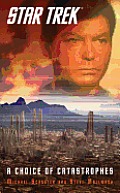
This is a new segment I've been thinking about for a while. There are a certain number of books that I get in the mail that I honestly just don't have time for. Then, there are books I hear are good, but that I just have no interest in. Your job, should you choose to accept it, is to convince me that I actually should give these books a try.
This first installment of "Convince Me" is a bit different from what I originally foresaw because I'm all but sure I want to read one of these books, I just need some direction....
It's confession time at Only the Best and I've got one big whopper of a confession to make. I've never read a Star Trek book. Never. Ever. That's not to say I haven't enjoyed the movies or the episodes of the TV show I've watched, but I don't think I can ever be accused of being a die-hard fan.
The Star Trek books seem to have their own unique subset of fans and I'm not even sure if the same people that read this blog and other blogs I read even read any. I hope to find at least a couple this way.
But I need some help. Who is a favorite author in the Star Trek universe? Where do I even start? Well, I at least have a starting point. I've received a total of 8 books as of today thanks to Pocket Books and I'd like to give at least one (if not more) a try. Please help me pick one.
Whether you've read these or not, whether you know anything about the Star Trek universe or not, I'd love to hear your opinion. Which book looks good to you? Please comment and let me know.
Welcome to the second part of my two part editorial on bias against speculative fiction. In the first part, The Origins of Bias: Speculative Fiction, I gave my brief and admittedly incomplete take on where I believe the bias against science fiction and fantasy originated, how it is propagated, and what I understand to be the objective reasons for its continued existence. Today, I am going to take a brief look at the future of science fiction and fantasy as it relates to popular perception.
An Industry in Decline?
Facts abound as to the generally poor economic viability of print media in the electronic age. Major newspapers are closing shop, and every week seems to herald the demise of one periodical or another. While, the economic depression has tightened belts across the board, it has also increased consumption of 'escapist' activities.
Borders issued a press release that suggested that its science fiction and fantasy titles were among the few that saw growth in the first quarter of 2009. How much of that is due to more people having free time to read or positive spillover from blockbuster movie titles is unclear. What is clear is that science fiction and fantasy are proving to be somewhat resilient in a market that has spared few other niches.
That said, I09 has a few posts quoting speculative fiction publishing insiders who claim that profits are "way down". Publishing industry statistics suggest that book sales were down close to 2.5% for the year, which to me seems to attenuate, at the very least, the "way down" hypothesis. Anyway, we are here to talk about bias, and popularity is only tangential to the topic, so lets get down to business.
Has the Blockbuster Taken the "G" Out of Geek
I have no doubt that if you are a fan of speculative fiction, you have gone to see at least one of the major movie releases in the last couple years. You would have to hate movies not to have done so. From any of the comic book franchises such as Spider Man or Iron Man, to the more glorious Lord of the Rings, or the record setting reboot of Star Trek, you are bound to have seen at least one of them. The huge success these franchises have fallen into has surely had some positive spillover on the science fiction and fantasy publishing industry. In fact, just last week they were selling a Star Trek book as I exited the theater.
The real question I want to get to is whether or not these movies have led to a shift in popular perception of science fiction and fantasy. Sadly, there is no simple answer to the question. To be sure, given the wide audience that these motion pictures have drawn in, it is safe to assume that it isn't "uncool" to see a sci-fi flick. Quite the contrary indeed if we are to look at the almost 80 million opening weekend that Star Trek achieved.
Sadly, unless someone would like to fund (or has found) a survey that sounds out people's interest in and view of science fiction and fantasy, my answer to the question is inevitably piecemeal. My personal take is that yes, the spate of awesome movies that have rocked our theaters is shifting perception of the genre. In addition, I think we see a lot of people funneled towards the wider world of science fiction and fantasy through video games and a bold resurgence in the comic book industry.
With the video game industry expected to outgrow music and movies by 2011, it might be more appropriate to have focused there. But then, video games never impact our popular opinion and collective consciousness nearly as much as movies do. I am reminded here of Activision-Blizzard's World of Warcraft add campaign that, when you boil it down, is telling you that playing a fantasy based massive multiplayer online RPG is the cool thing to do. Boasting a paying player base of nearly twelve million certainly says something about the adds success.
I'm going to cut myself short and conclude my two part editorial to let you leave with a laugh after watching Mr. T. I am really interested in what your take is on the current popular view of science fiction and fantasy, so drop a comment if you have the time.
Disclosure: Assume all links are affiliate links (i.e., we get paid a small percentage). That helps run the blog and do what we do, which is mostly reading more books.