Showing posts with label China Mievillle. Show all posts

07 April, 2011

Interview - China Miéville

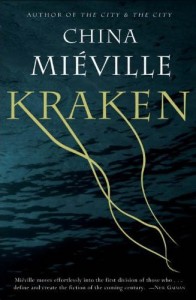
As I announced before, Kraken (my review) was the winner of the first ever Independent Literary Award for Speculative Fiction. Not only, as panelists and judges, were we able to enjoy Kraken, but we had the great opportunity to bombard Mr. Miéville with questions as well. He was nice enough to oblige.


These questions come from not only myself, but Jared (from Pornokitsch), and Jamie (from Mithril Wisdom) as well as some folks at sffworld.com. Make sure to check out their awesome blogs and the forums, especially since Jared did a lot of work getting in touch with China.

**********

1. Why a Kraken? Don't get us wrong, we love Krakens, they're awesome, but why did you center the book around one?

When they got a giant squid for the Natural History Museum in London, what was I going to do, not lose my shit with excitement? Please. So I went, several times, as of course I was always going to, and it was as astonishing as one would imagine, to see a creature like that, in a tank like that, in a room like that. I'm a cephalopod fan, of course, a lurker at TONMO, a lover of ammonites and belemnites, cuttlefish, argonauts, squid and all of them. I was always going to write something revolving around a tentacled beast at some point. I'm a verbose lover of them, though in my own soul, the octopus unquestionably looms largest. Nonetheless, the squid - the giant squid in particular - has a cultural presence that none of the others can match, so it really did feel like having a myth right there in the room. Pickled. So that was the start. It's less, in truth, the Krakenness than the Giant Squidness of the thing that was the spur. The equation of the two is an arguably tendentious innovation of modernity, though one I'm perfectly happy to go along with.

2. The idea of parallel universes comes up a few times in your work (as in The City and The City and Kraken). This is definitely an interesting concept, but what has led to this concept in your work?

Sadly I think I, like most writers, am singularly ill placed to answer the question 'what has led to' any particular concept in the books. Not that that stops any of us trying to answer it, of course, but God knows when we do it tends to be awful waffle, because what do we know? In this case I'm tempted to say something along the lines of, oh, any SF writer and/or reader is always-already interested in alternate universes, in alterity. I, like everyone working in the field, feel a tug from the unreal. But parallelism in particular, I don't know. I'm not even sure I recognise that in my stuff (which is not of course to say it's not there), or, quite, what it is.

What makes another universe parallel, specifically? It's obviously in the eye of the beholder, and I think is something to do with nearness, with otherness-but-recognisability. Is that at all convincing? In the case of your question, I'm intrigued by the idea that there are parallel worlds implied in Kraken, or indeed in TC&TC. Because... minor spoilers!... for both, and particularly in the latter case, that is, I think, by no means self-evident. (I might even go further and say, about TC&TC, that it's very much predicated on the numbingly everyday. Though I realise that does not make it sound particularly appealing. Fail.)

3. In an interview, you said that Kraken marked the "end of a certain phase of my writing - a punctuation mark, a sort of breathing out." Can you expand upon this a bit? How do you think about the phase that has ended - what typified it? - and what comes next?

That's a very interesting question. I suppose it's something to do with the fact that for various reasons, Kraken was written over quite a long time. The City & The City was written at about the same time, and feels to me, and I think to some readers, quite different in voice to my previous books. Kraken, by contrast, was a kind of loving valedictory to what I hope is an enjoyable but rather chaotic kitchen-sink excess of the Bas-Lag books. It's a book all about totality, it's full of stuff, it attempts - whether successfully or not - to make a virtue of a certain kind of, I hope not exactly ill-discipline, but sort of distraction, like the book itself gets distracted, but that those distractions, I hope, are engaging. (Something that no one I've ever read does as well as Pynchon, to whom this book is, among other things, a tentacular pulp homage.)

I don't intend necessarily to pare down my writing and go 'minimal' all the time (I couldn't, even close), but at the moment I'm drawn at least to a different style of focus and voice, perhaps more like TC&TC. So that rumbustiousness of Kraken feels affectionate and even a little nostalgic.

4. I loved the idea of a spirit-being only being able to inhabit human-shaped objects. What was the inspiration for Wati? How did that come about?

It's always tough (and generally misleading) trying to reconstruct the order of these things, but insofar as I recall, Wati came from a concatenation of at least three events. i) Reading about the shabti, the servant-statues, in some book about ancient Egypt, and being absolutely blown away by the idea of such entities. Obviously, it's an exciting idea for someone interested in labour politics, like me. ii) The fact that for my 30th birthday (long before I wrote Kraken) my sister gave me a genuine (and, I add hastily, legitimately sourced) little Egyptian shabti. iii) Thinking about when Mickey magics the broom servants and orders them to carry the water in Fantasia - the notion that how it all goes wrong for him could represent a form of industrial strife and resistance on the part of his brooms. As to Wati's inhabiting of figures and figurines, I think I liked the idea of him ornerily appropriating made and constructed figures, a sort of expropriation, a statuary fuck-you.

5. “Is Urban the new Fantasy”?

I'm sorry, I literally have no idea what this means. I'm not being cute, I promise, I just don't think I understand what this is getting at. Do you mean 'there sure is a lot of urban fantasy around at the moment'? Because yes my goodness me there is. Do you mean 'The adjective "urban" is becoming increasingly disaggregated from what one might have thought its referent would be, and instead portending various fashionable aesthetic tropes actually contingent to metropolitan quiddity'? Also yes, it is, is it not? Will this pass? This too shall pass.

6. You seem to write mainly stand-alone works - and even the Bas-Lag books would fit that description. Do you have any future plans to write a series?

Never say never, of course, but I sort of doubt it. There's a bunch of reasons for this, but they mostly boil down to some variant or other of a predilection for texts that work as a totality. (This is, I suspect, just a way of saying I prefer standalones because I prefer standalones, and unprefer non-standalones.) That doesn't mean no sequels, necessarily, and obviously I like (and have done) books set in a shared setting, but that's different. I feel I think these days a bit ground down by the saga-ness of sagas, even where I admire them. And I have and do - for me, for example, Steven Donaldson's Thomas Covenant books were a huge thing, I'm a great admirer of John Crowley, whose Aegypt series is very much a series, and so on. But overall I suppose I'm attracted to the idea of narrative, of stories, being sort of contingent, extracted wilfully from a mess, which means that I like the idea of overlapping-because-messy stories, that are connected yes, because tugged out of an impossibly complicated tangle, but also distinct precisely because their edges are (like all stories' are) constructed, decided. We don't find stories, we make them, in real life and in fiction. After all it's no happy chance that they perfectly fill the book allotted them (hey, how about that!): the book ends because the edge of the story has been declared. It's as manipulative a decision to enseries a story as it is to end it with the last page.

While I really love loving cultural bumph, like books, movies, etc, I vaguely detect in me a disinclination to get addicted to series in any medium (post-Buffy I tend to assiduously avoid watching things on tv that I think might hook me as series, though I'm generally cheerful about individual episodes), which I think is perhaps related to my ongoing and extreme anxieties about time-management, and about frittering time away. So - and this is post-facto hypothesising - it might feel to me a bit hypocritical to attempt to addict others to such things.

Anyway, a book that starts and middles and ends pleases me.

7. The "Remade", from Perdido Street Station, are convicts that have been physically altered or bioengineered with any number of animal and/or mechanical parts grafted on. How did this idea come about and is it a look at punishment versus rehabilitation in a penal system?

I like grotesquerie. Part of, indeed for me a very if not the major, appeal of writing the fantastic has always been the creation of monsters, as many and as varied as possible. And with the Remade, with a category of person defined by their variability, I gave myself leeway to produce as many different physical monstrous forms as I could possibly come up with without having to endlessly rationalise them as new species. It wasn't just licence, it was encouragement, to indulge as baroque a teratogenesis as I could. And combined with that it raised (in what I hope isn't/wasn't too camply overt a manner) issues of crime, punishment, state power, the body, what has been called biopolitics, and so on. To that extent it is absolutely, as you imply, about the politics, culture and economics - and performance - of punishment, especially by the state.

Personally though I wouldn't tend to stress the terms of punishment *versus* rehabilitation, because those very terms of debate, which purport to represent the 'opposing wings' of possible opinion, restrict the conceptual terrain. Both of them, whether from a hawkish or a putatively dovish perspective, maintain the notion of crime as malignant social pathology, with the debate being over how best to address that Bad Behaviour™. Obviously lots of crime is terrible, and our task should be to understand where it came from, take care of those hurt by it and do whatever necessary to stop it happening again. But a worthy discussion of the penal system has to point out that of course i) our world is structured by countless unspeakable, violent, maleficent acts perpetrated every day by those in positions of power, from imperial wars to corporates'/the rich's tax evasion - or to give it its other name, stealing from hospitals - that are ignored, if technically 'illegal' in the first place, and are very often even culturally celebrated; and ii) colossal amounts of crime at the other end of things are not social pathologies at all - the infamous 'looting' after Katrina, otherwise known as 'attempting not to starve', would be an extreme case in point, but plenty of illegalities that occur are wholly predictable acts of survival, everyday efforts to get by, reasonable desires to experience a bit of pleasure, in many cases deliberately made illegal to justify oppressive structures of martial law (hello, 'War On Drugs'), and that deserve neither punishment nor rehabilitation, but instead illustrate the urgent necessity to change a society where such activities are so brutally pathologised.

8. Anything you can tell us about what to expect from Embassytown?

I'm very bad at answering questions like this because my own druthers tend to be to go into a book knowing as little about it as possible. That doesn't stop one expecting things, of course, but it would be best, I think, if a book could totally confound expectations and still win you over.

With that in mind, therefore, some, but not all, of the following hints about what's in Embassytown are lies: language; aliens; the politics of glass; metropole-periphery interaction; disguised unicorn riffs; cameras that act like wasps; cameras that act like bones; Spinozan astrophysics; comic poetry; shenanigans.

9. What does your tattoo mean?

The one on my arm? The short answer is it is a simultaneous homage to two radically countervailing traditions of the fantastic to which I owe fealty and love. The shorter answer is it is an incompossibility. The long answer is this piece , particularly between pages 123 and 127.

06 April, 2011

Review - Kraken by China Miéville


First off, a book with the title Kraken is required to have a sinking ship attacked by a Kraken or at least have the line "release the Kraken" make sense. Sorry, it's in the rules...This did not have any.

If that's what you're looking for, look elsewhere, although if you know anything about Mieville (I'm told), you should know that you never really get what you expect from his novels.

Kraken [US] [UK] was my first crack (or should I say krak) at China Mieville outside of the 100 or so pages I read of Perdido Street Station [US] [UK], which I do plan to someday finish. This is one of those books that leaves an indelible impression on you for a very long time after. This is also why I changed my rating a few days later (in the upward direction) as I'll explain in a bit.

Throughout the book, I was thinking I'd give Kraken at most a 2 out of 5.
I have to applaud the imagination the Mieville has. It's impressively insane. He not only has the craziest characters/entities/whatchamacallits, but he describes them in a way that makes it completely believable in the world he's created. It's quite amazing and I'd say Mieville's worth a read for the sole opportunity to have your mind blown with an extremely unique take on a fantasy novel.

The problem, and the reason for the initial rating, was that I felt so bogged down in the imagination, in the vivid descriptions and interesting characters, that I didn't feel like there was really any progression to the story; any reason to continue besides to find out about more cool creatures. This was much the same reason I stopped reading Perdido Street Station part-way through, although to a much larger degree. Like I said, I will get back to it as I now know it will all be worth it in the end.

The tale's protagonist, Billy Harrow, is a curator at Natural History Museum in London and its biggest draw, and on which Billy has personally worked, is the Giant Squid - Architeuthis dux. The only problem is that it's suddenly disappeared...out of nowhere...with no trace whatsoever.

Thereafter, Billy finds himself in a London that is not the same London he knew before he found the Kraken was gone. There are cults and gangs, creatures and spirits, Billy never would have believed existed including the notorious gang leader Tattoo, who is actually a tattoo of a face on the back of an unwanting punk, and Wati (my favorite), the Egyptian spirit who can only inhabit figurines and statues that are at least mostly human shaped.

The problem for Billy is that all these groups in this underground London think Billy is behind it all and he doesn't know a thing.

Like I said earlier, Kraken is amazingly imaginative and it stays with you long after you read this book, as I'm told are many, if not all, of China Mieville's work. The more I get away from reading this book, the more I find myself still thinking about it. It really was an enjoyable book that I'd definitely recommend.

Because this is my first Mieville book, I'm not the expert, but I've read this is the most linear and accessible of all his work.

Why Should You Read Kraken?

Well, don't read it if all you wanted were pirates and ships and sword-fights, etc. You won't get any of that. What you will get is a great book filled with characters and creatures that you can't believe how real you think they now are. :) (like henchmen that have actual hands, fingers and everything, for heads)

4 out of 5 Stars

06 March, 2011

Review - Kraken by China Miéville

First off, a book with the title Kraken is required to have a sinking ship attacked by a Kraken or at least have the line "release the Kraken" make sense. This did not have any. Sorry, it's in the rules.

If that's what you're looking for, look elsewhere, although if you know anything about Mieville (I'm told), you should know that you never really get what you expect from his novels.

Kraken [US] [UK]was my first crack (or should I say krak - hehe) at China Mieville outside of the 100 or so pages I read of Perdido Street Station [US] [UK], which I do plan to someday finish. This is one of those books that leaves an indelible impression on you for a very long time after. This is also why I changed my rating a few days later (in the upward direction) as I'll explain in a bit.

Throughout the book, I was thinking I'd give Kraken at most a 2 out of 5.
I have to applaud the imagination the Mieville has. It's impressively insane. He not only has the craziest characters/entities/whatchamacallits, but he describes them in a way that makes it completely believable in the world he's created. It's quite amazing and I'd say Mieville's worth a read for the sole opportunity to have your mind blown with an extremely unique take on a fantasy novel.

The problem, and the reason for the initial rating, was that I felt so bogged down in the imagination, in the vivid descriptions and interesting characters, that I didn't feel like there was really any progression to the story; any reason to continue besides to find out about more cool creatures. This was much the same reason I stopped reading Perdido Street Station part-way through, although to a much larger degree. Like I said, I will get back to it as I now know it will all be worth it in the end.

The tale's protagonist, Billy Harrow, is a curator at Natural History Museum in London and its biggest draw, and on which Billy has personally worked, is the Giant Squid - Architeuthis dux. The only problem is that it's suddenly disappeared...out of nowhere...with no trace whatsoever.

Thereafter, Billy finds himself in a London that is not the same London he knew before he found the Kraken was gone. There are cults and gangs, creatures and spirits, Billy never would have believed existed including the notorious gang leader Tattoo, who is actually a tattoo of a face on the back of an unwanting punk, and Wati (my favorite), the Egyptian spirit who can only inhabit figurines and statues that are at least mostly human shaped.

The problem for Billy is that all these groups in this underground London think Billy is behind it all and he doesn't know a thing.

Like I said earlier, Kraken is amazingly imaginative and it stays with you long after you read this book, as I'm told are many, if not all, of China Mieville's work. The more I get away from reading this book, the more I find myself still thinking about it. It really was an enjoyable book that I'd definitely recommend.

Because this is my first Mieville book, I'm not the expert, but I've read this is the most linear and accessible of all his work.

Why Should You Read Kraken?

Well, don't read it if all you wanted were pirates and ships and sword-fights, etc. You won't get any of that. What you will get is a great book filled with characters and creatures that you can't believe how real you think they now are. :) (like henchmen that have actual hands, fingers and everything, for heads)

4 out of 5 Stars

24 February, 2011

It's News To Me #6

I know I'm a couple days late on this news, but I had to make some mentions since I'm ever so excited about it. :) This week's been insane.

China Mieville gets a face-lift:
A couple of my favorites are show below, but you can get a full showing at Werty, Mad Hattsalot, Dribbles of Ink, and more. I really Tor UK did a great job with these covers, representing Mieville's common theme of worlds within worlds


Peter Orullian's The Vault of Heaven Series:
Publicity has ratcheted up a notch not to mention the ARC's are already making their way around. There are a few stories, Sacrifice of the First Sheason and The Great Defense of Layosah, an awesome interactive map, and even a couple videos:

Cradle of the Scar -

Part 1: Grant


Part 2: Kaela


(Thanks to The Mad Hatter for putting it all in one handy dandy place)


2010 Nebula Awards: The award that's voted on and presented by members of SFWA has posted some short lists. I've really failed this year, only having read one of the YA nominees. Ouch. :)

Novel

Short Story

Novelette

Novella

The Ray Bradbury Award for Outstanding Dramatic Presentation

  • Despicable Me, Pierre Coffin & Chris Renaud (directors), Ken Daurio & Cinco Paul (screenplay), Sergio Pablos (story) (Illumination Entertainment)
  • Doctor Who: ‘‘Vincent and the Doctor’’, Richard Curtis (writer), Jonny Campbell (director)
  • How to Train Your Dragon, Dean DeBlois & Chris Sanders (directors), William Davies, Dean DeBlois, & Chris Sanders (screenplay) (DreamWorks Animation)
  • Inception, Christopher Nolan (director), Christopher Nolan (screenplay) (Warner)
  • Scott Pilgrim vs. the World, Edgar Wright (director), Michael Bacall & Edgar Wright (screenplay) (Universal)
  • Toy Story 3, Lee Unkrich (director), Michael Arndt (screenplay), John Lasseter, Andrew Stanton, & Lee Unkrich (story) (Pixar/Disney)

Andre Norton Award for Young Adult Science Fiction and Fantasy


And that's the news...at least to me.

13 January, 2011

Great Quotes

...or even marginally decent ones.

Been reading Kraken by China Mieville lately and found this little ditty that had me chuckling:
"I wouldn't say danger," said Baron. "I'd say at the very worst it's dangish..."
Good reading so far and I can tell it's only going to get better.

31 October, 2009

Bona Fide: Weekly Roundup #44


Hello and welcome to issue #44 of my Weekly Roundup. As promised I don't talk about time. But maybe you have been a bit surprised that we didn't post every day. The reason for that is simple: Alec was busy with other stuff and I don't have the capacity to write more. Yay! I didn't use the magic word t**e. Did you notice? In two months time is Christmas! I started to think about Christmas gifts, especially my own wishes. Beginning with this Roundup I will add a section where I will talk about possibly gifts and so on. And now enjoy reading.....

Bona Fide's Menu

Books
  1. Shelf discovery of the week: Perdido Street Station by China Miéville
  2. Book trailer: Burn Me Deadly by Alex Bledsoe
  3. Jane Austen on a Sci-Fi Fantasy blog?
  4. Good news for steampunk fans from Lou Anders, Editorial Director of Pyr
Blogosphere
  1. "The Kraken"
  2. New PAX BRITANNIA logo
  3. My tribute to Halloween
Movies
  1. Avatar - New International Trailer
Xgifts
  1. My first choice: Memory, Sorrow & Thorn by Tad Williams
Quotes
  1. German proverbs and Halloween quotes

Books

Shelf discovery of the week
I love steampunk. So I must ask myself why I didn't read my discovery of the week so far. I lost sight of it. I talk about a book which won several prices like The British Fantasy Society Award and The Arthur C. Clarke Award. It also has been nominated for the Hugo Award, Nebula Award and the World Fantasy Award. And the book is: Perdido Street Station (2000) [US][UK], by China Miéville.
"Beneath the towering bleached ribs of a dead, ancient beast lies New Crobuzon, a squalid city where humans, Re-mades, and arcane races live in perpetual fear of Parliament and its brutal militia. The air and rivers are thick with factory pollutants and the strange effluents of alchemy, and the ghettos contain a vast mix of workers, artists, spies, junkies, and whores. In New Crobuzon, the unsavory deal is stranger to none—not even to Isaac, a brilliant scientist with a penchant for Crisis Theory. Isaac has spent a lifetime quietly carrying out his unique research. But when a half-bird, half-human creature known as the Garuda comes to him from afar, Isaac is faced with challenges he has never before fathomed. Though the Garuda's request is scientifically daunting, Isaac is sparked by his own curiosity and an uncanny reverence for this curious stranger. While Isaac's experiments for the Garuda turn into an obsession, one of his lab specimens demands attention: a brilliantly colored caterpillar that feeds on nothing but a hallucinatory drug and grows larger—and more consuming—by the day. What finally emerges from the silken cocoon will permeate every fiber of New Crobuzon—and not even the Ambassador of Hell will challenge the malignant terror it invokes . . . A magnificent fantasy rife with scientific splendor, magical intrigue, and wonderfully realized characters, told in a storytelling style in which Charles Dickens meets Neal Stephenson, Perdido Street Station offers an eerie, voluptuously crafted world that will plumb the depths of every reader's imagination." [Source: From the back of my copy of the book]

Book trailer
I'm a big fan of sword-jockey Eddie LaCrosse. I reviewed The Sword-Edged Blonde and Burn Me Deadly. Both are awesome reads by Alex Bledsoe. Only a few days to go until Burn Me Deadly will hit the book stores. In the meantime enjoy the book trailer.


Jane Austen on a Sci-Fi/Fantasy blog?
Hope you don't think I'm going crazy. I never read a Jane Austen novel so far. It is not my taste. But maybe I will change my mind. You will understand why as soon as you have watched the following book trailer.


Good news for steampunk fans
Read the following lines...
"It is 1861, and the British Empire is in the grip of conflicting forces. Engineers transform the landscape with bigger, faster, noisier and dirtier technological wonders; Eugenicists develop specialist animals to provide unpaid labour; Libertines oppose restrictive and unjust laws and flood the country with propaganda demanding a society based on beauty and creativity; while The Rakes push the boundaries of human behaviour to the limits with magic, sexuality, drugs and anarchy.
Returning from his failed expedition to find the source of the Nile, explorer, linguist, scholar and swordsman Sir Richard Francis Burton finds himself sucked into the perilous depths of this moral and ethical vacuum when the Prime Minister, Lord Palmerston, employs him as “King's Spy.” His first mission: to investigate the sexual assaults committed by a weird apparition known as Spring Heeled Jack; to find out why chimney sweeps are being kidnapped by half-man, half-dog creatures; and to discover the whereabouts of his badly injured ex-friend (and new enemy), John Hanning Speke.
Accompanied by the diminutive and pain-loving poet, Algernon Swinburne, Burton's investigations lead him back to one of the defining events of the age: the brutal assassination of Queen Victoria in 1840; and the terrifying possibility that the world he inhabits shouldn't exist at all!" [Source]
I got totally excited! This is the description of Mark Hodder's Burton & Swinburne in The Strange Affair of Spring Heeled Jack, the first of a planned new series. And Lou Anders aquired author and book for Pyr. But, but but there is one downer - the book is not scheduled yet!! Lou Anders expects the book in the US around fall 2010......


Blogosphere

"The Kraken"
Do you believe in seamonsters like The Kraken? No? Maybe you need some more information and a bottle of "The Kraken Black Spiced Rum". Please don't get me wrong. The following videos are commercials. But they are worth to watch. You will get interesting information about the "Kraken". This is chapter one. For chapter two and three please follow the links.

Chapter Two and Chapter Three. Now you may ask where I found this stuff. I follow Steampunkopedia which is an extraordinary steampunk compendium.

New PAX BRITANNIA logo
After 18 months Jonathan Green decided that the time has come to change the logo of PAX BRITANNIA.
On the left side you see the new logo. What do you think about it? Is it the right one for a steampunk series?

Got to PAX BRITANNIA and leave your comment. Jonathan Green would like to know what you think about it. I left my comment.
For more information about the series read my post The World of PAX BRITANNIA. I also reviewed the latest book of the series: Evolution Expects.

My tribute to Halloween
I live in Germany and we don't have a real Halloween tradition. But I think I found my appropriate tribute to Halloween. The following three names should ring a bell in you: Tim Burton, Vincent Price, Edgar Allan Poe.

Let's start with Tim Burton's Vincent which is pays homage to Vincent Price and Edgar Allan Poe.


After this prelude watch the awesome Vincent Price giving The Raven


And finally enjoy the virtual Edgar Allan Poe reading his great poem "The Raven"


Movies

When I watched the first teaser trailer of Avatar - the forthcoming 3-D film by James Cameron - I have been a bit disappointed. But now the new international trailer is available. And it is much better. The movie will hit the cinemas on December 18th.


Xgifts

Twice a year I create a list of things I wish. My family appreciates to have a choice. Last Christmas I got all available books of the Malazan Empire. This year is a bit different. For the first time I want to reread a series:
Memory, Sorrow and Thorn by Tad Williams. The whole series (four books in paperback) has been reissued by Orbit UK. The US cover is different. Anyway all books are available. And this is book one: The Dragonbone Chair (2009) [US][UK]:
"THE DRAGONBONE CHAIR is the story of Simon, a young kitchen boy and magician's apprentice, whose dreams of great deeds and heroic wars come all too shockingly true when his world is torn apart by a terrifying civil war -- a war fueled by ancient hatreds, immortal enemies, and the dark powers of sorcery. In Osten Ard, a land once ruled by an elvishlike race known as the Sithi, the human High King is dying. And with his death, a long-dormant evil is unleashed on the land as the undead Sithi ruler, the Storm King, seeks to regain his lost realm through a pact with one of human royal blood. Driven by spell-inspired jealousy and fear, prince fights prince, while around them the very land begins to die, poisoned by a sorcerous force sworn to annihilate the humans whose ancestors had driven the Sithi from their rightful home long ages ago. Only a small, scattered group, the League of the Scroll, recognizes the true danger faced by Osten Ard, only they hold the knowledge of times past, of threats fulfilled, and of a riddle of swords, which holds out the one small hope of salvation. And to Simon -- unknowingly apprenticed to a member of this League, and unwittingly touched by magic both good and ill -- will go the task of spearheading the search for the solution to this riddle of long-lost swords of power, a quest that will see him fleeing and facing enemies straight out of a legend-maker's worst nightmare"[Source]
And these are the sequels: The Stone of Farewell (2009) [US][UK], Siege (2009) [US][UK] and Storm (2009) [US][UK].

Quotes

I missed my quotes. Therefore I decided to present a few beside the presentation of German proverbs. And again I used wikiqoute as my main source.

" *Wie Pech und Schwefel.
Lit.: "Like pitch and sulphur."
Meaning: "E.g. good friends, who are inseparable or/and make all together, are like pitch and sulphur."

" * Wie man sich bettet, so liegt man.
Literally: "As you put yourself to bed, so you will lie."
Meaning: "You made your bed, now lie in it."
Meaning: Everyone makes his own fate."

" One need not be a chamber to be haunted;
One need not be a house;
The brain has corridors surpassing
Material place.
"
Emily Dickinson

" When black cats prowl and pumpkins gleam,
May luck be yours on Halloween.
"
~Author Unknown

" There are nights when the wolves are silent and only the moon howls."
~George Carlin

28 August, 2009

Bona Fide's Two Cents: Seven Essential Second-step Fantasies

On 12th of August 2009, The New Yorker posted an online-article about fantasy book recommendations for readers of books like "Harry Potter, The Lord of the Rings, His Dark Materials, Twilight, Narnia, A Wrinkle in Time, The Dark Is Rising." Of course this list aroused interest and it didn't take long until you could read about it on several blogs. I don't want to bother you with a long list of links. I recommend to read the article by Aidan over at A Dribble of Ink. I mostly agree with him except The Anubis Gates by Tim Powers because it did not work for me.

From the original list I read five books. I didn't read The Scions of Shannara by Terry Brooks and nothing by Guy Gavriel Kay.

That lead me to questions: Am I a fantasy book lover? Am I experienced enough to comment this list? Is it hubris when I try to recommend other books?

As I told you before I'm a fan of Aidan's list but there are still books which I recommend which are not mentioned there. That means I didn't create my own list. I just present you some proposals. Anyhow there are still too many books I have not read so far.....

I start my recommendations with The Last Rune series by Mark Anthony. I don't want to repeat my last post. So please read Bona Fide: Living in a Fantasy World? for more information. I think this series is proper next step for readers of Harry Potter and Narnia. It delivers two worlds and adult heroes.

I'm not a fan of Twilight. But within this year I read a book which shows completely different vampires. I'm talking about Fevre Dream [US] [UK] by George R. R. Martin which has been published first in 1982. I know that Twilight and Fevre Dream are like two sides of coin. That means it is a challenge for Twilight readers.


I liked to read the following two books after Harry Potter - yes I have read all Potter books.

The first one is Un Lun Dun (2007) by China Miéville [US] [UK]. A book with exuberant imagination. You will meet an extraordinary house pet: Curdle, an empty milk carton. Discover the secret life of broken umbrellas and, and, and, ......


The second one is a bit older but still worth reading.
Discover a bizarre realm beneath London and follow Richard Mayhew into a world full of monsters, saints, murderers and angels in Neverwhere (1996), by Neil Gaiman [US] [UK].


Now I want to direct your attention to a historical fantasy book. As I don't know Guy Gavriel Kay I would like to recommend: Midnight Never Come (2008) by Marie Brennan [US] [UK]. This is the first book of The Onyx Court series. The books (so far Marie Brennan has signed a contract for four books) in this historical fantasy series are set in my favorite town, London, and cover different periods of English history. The title of the book is derived from The Tragical History of Doctor Faustus by Christopher Marlow [Free online read].

"Now hast thou but one hower to live
And then thou must be damned perpetually:
Stand stil you ever moving spheres of heaven
That time may cease, and midnight never come!"

For more information please read my review.

My last recommendation is a real intense book and I know a lot of people will tell me that it is no fantasy from a technical point of view. And it is a big book (more than 900 pages). But when you like an awesome story with a historical background then there is no way out to read Terror (2007) [US] [UK] by Dan Simmons.
He tells the story of the last expedition of John Franklin, who tried to find the Northwest Passage in 1845 with the ships HMS Terror and HMS Erebus. Based on the know facts, Dan Simmons presents an expressive and quite impressive metaphor of the expedition. I felt the cold on nearly every page. Let's not forget the intense description of the feelings of the expedition members. Beside all the obvious fun, the reader gets to learn a lot about the customs and traditions of the Eskimos.
The appendix contains the list of crewmembers, a glossary and explanations of Eskimo terms. I recommend this book warmly to everyone who is interested in Arctic Zones, Explorers, and the depths of the human soul.