Showing posts with label military science fiction. Show all posts

18 October, 2010

Review: The Truth of Valor, by Tanya Huff

The Truth of Valor [US][UK] is the fifth installment in Tanya Huff's tightly plotted military science fiction Confederation series (review). Narrower in scope than its predecessors, The Truth of Valor finds our favorite Gunnery Sergeant Torin Kerr madly in love with a deep space salvage operator and trying her best to learn a life that doesn't involve artillery barrages or assault rifles. Unfortunately for the new couple, space just isn't vast enough to avoid trouble... or pirates.

The Truth of Valor takes the Confederation series down to a more personal level, focusing on the relationship between Kerr and Craig Ryder as well as the emotional scars Kerr still bears from her previous adventures. For all of the novel's adrenaline filled last second escapes from certain death, it also showcases a deeper focus on the moral implications associated with the use of deadly force. While many of Kerr's battles have been both personal and emotional, they have always taken place in the context of a military hierarchy supported by the strongest of moral justifications. This time around, readers are given a glimpse of the real Kerr, separate from her military persona, but still kicking ass.

Don't let my lofty talk about the deeper issues distract you form the fact that The Truth of Valor is one hell of a ride. While the book is perhaps not the best in the series, it certainly hits many of the same high notes and is sure to delight any and all fans of military sci-fi. Tanya caters to her audience by relying on her strengths in this book. Readers familiar with the series will enjoy the cross-species interactions - and sex - as well as the playful banter and inner monologues emblematic of the Confederation series as a whole.

My main gripe, and the one I make about virtually every series i read, is that the book answers none of the series' meta questions. Much like Kerr, readers are in the dark as to the greater going's on in the universe she inhabits. No news about the war between the Primacy and the Confederation besides brief references to the fact that it is still going on. No news about the sentient poly-numerous plastic that controls the universe and instigated the war in the first place, besides a deus-ex moment at the end of the novel. I mean come on, I need some closure here!

If you haven't started on the Confederation series, none of this will be making any sense. Start with Valor's Choice and get back to me.

The Truth of Valor is your standard space pirate adventure where the good guys come close to loosing way too many times for comfort. The fast pace and low word count will make for a quick and enjoyable read. Torin Kerr is essentially the Bruce Willis of military science fiction... if Mr. Willis were a woman and lived in the future. They both always end up banged up at the end of their adventures, and the bad guys always go boom in a very satisfying explosion.

Highly recommended for readers of less lofty titles who enjoy action... in space.

26 August, 2010

(Audiobook) Review - On Basilisk Station by David Weber

Honor Harrington is young and already looking to have quite the military career and she's just been given her first full-fledged starship, the HMS Fearless. But, almost immediately she learns, not everything's quite what it's cracked up to be.

The HMS Fearless, Harrington's new command, is stripped of its usual weapons systems and supplied with newer, less fully tested tech. Harrington and her crew suffer defeat after defeat during the fleet war games; adding fuel to the crew's disappointment with their new captain, not to mention getting them sent to the backwater of the universe, Basilisk Station.

While up to this point, Harrington's career had been more than promising, it's starting to look even more bleak as political maneuvering ensues and she is left in insurmountable situations. But... that's where Honor Harrington thrives the most.

On Basilisk Station [US] [UK] is the first book in David Weber's ongoing Honor Harrington series. This series is already at 12 books (yep, I'm a bit late to the game) and as far as I know and until I'm corrected, there's no end in sight.

After taking quite a bit of time for me to get into, and I'll address this in the Audio Commentary section, in the end I enjoyed On Basilisk Station. It's hard not to root for the underdog and that's where Honor Harrington spends most of the book - fighting against the odds.

Honor Harrington is just a hard character not to root for in general. She's calculated, cool under pressure, and really sticks it to anyone who thinks they can push her around. Those moments in the book are definitely the most fun whether it was outside forces or her own crew, but man does she stick it to them.

Audio Commentary

I have to admit, I had a hard time getting into this book, but the more I listened, the more I realized it was the audio portion itself, not the story or characters, that was preventing my full enjoyment. The narrator was really hard to follow as her voice was mostly monotone and boring.

Plus, most of the characters just had accents from different countries to distinguish them and I thought that was a bit odd.

The AUDIOBOOK is NOT RECOMMENDED.

On the other hand, the story, characters, and plot are all great, especially if you're a fan of military sci-fi. I do plan on continuing the series at some point, although the 12 book series does sound daunting, so I'll make no promises, although I'm captivated enough to want to read the next one.

READING is RECOMMENDED.

3 out of 5 Stars (I think this would be higher had I read, not listened to, the book)

On Basilisk Station and The Honor of the Queen (Honor Harrington Book 2) are both available for free at the Baen Free Library.

08 June, 2010

Review: The Killing of Worlds and The Risen Empire, by Scott Westerfeld

In his Succesion [US][UK] series author Scott Westerfeld, better known for his more recent Leviathan (2009) brings the tangled geometries of space warfare into keen focus, delighting readers with his meticulous rendering of complex stroke and counter-stroke in truly stellar space battles. The Succesion books – The Risen Empire (2003) and The Killing of Worlds (2003) are hard edged military science fiction at its finest, combining crisp and incisive writing with a knack for drawing almost as much adrenaline from readers as from protagonists. Highly recommended for military science fiction aficionados and first time genre adventurers alike.

In a distant future (dum dum dum) where humans have spread across the galaxy, two civilizations are on the verge of war. One is ruled by an immortal Emperor who has discovered a cure for mortality; the other, knows as the Rix, is composed of technologically augmented humans who worship planet scale AIs. The story hits critical mass when, as the Emperor’s sister is visiting one of his civilization’s many worlds, she is taken hostage by a group of elite Rix commandos. The Lynx, the most advanced military vessel ever produced by the Risen Empire is tasked with freeing the Emeror’s sister and protecting the secret to immortality.

One of the greatest strengths of Westerfeld’s narrative is the way in which it meshes immeasurably different perspectives into a coherent, and I might add fascinating, story. From battles waged on microscopic scales by remote controlled craft to mile long rail guns capable of firing relativistic bullets, Westerfeld impresses at every turn with immaculately choreographed violence. Strategy and strength, luck and logic all play their part and combine to create a story that is as logically consistent as it is compelling.

I often find myself trying to categorize authors I have not read in terms of authors that I have read. Thus, I am best able to describe Westerfeld’s Succession series (originally published in England as one book) as an immensely satisfying mix of David Weber and Richard Morgan. In terms of style, scale and world building, the Succesion series closely resembles the world inhabited by Honor Harrington - especially with respect to the crisp mathematical geometries of space combat. Then again, there is an element of both the tragic and romantic – a focus on the more personal logics that reminds me of Takeshi Kovacs in Altered Carbon – the pacing is similarly brutal.

Regardless of what the Succession series best compares to, it was an immensely enjoyable read from my perspective. Admittedly, I am a glutton of military science fiction, but I imagine that by the standards of any science fiction or fantasy fan, The Risen Empire and The Killer of Worlds will make for some quick and enjoyable reading. With few notable flaws besides perhaps some convincingly presented strategic inconsistencies, The Succession series belongs at the top of your reading pile if it isn't already on your shelf.

17 May, 2010

Review: Trading in Danger, by Elizabeth Moon

Trading in Danger, by Elizabeth Moon, Vatta's War Series
Trading in Danger [US][UK], by Elizabeth Moon, is a military science fiction adventure that begins the Vatta’s War series. This first installment introduces readers to Ky Vatta, an officer-candidate dropout that draws danger like iron to a lodestone – and manages to miraculously survive impossible situations.

Trading in Danger is a fun read that quickly builds the necessary momentum to keep readers hooked. Genre veterans will find the heroine and plot startlingly akin to Weber’s Honor Harrington and Tanya Huff’s Torin Kerr, with perhaps a few empire building capitalist tendencies thrown into the mix – galaxy spanning trade empires are, after all, not built overnight.

Ky Vatta is the quintessential protagonist. She is young, brilliant and invariably lucky. Her expulsion from officer-candidate school – for being overly trusting - sees her put at the helm of one of her family’s many intergalactic trading ships. Following the family philosophy of “trade and profit”, Ky quickly manages to get her ship embroiled in a “small local conflict” that fails to remain small. War, betrayal, sabotage and revenge ensue. How fun!

Trading in Danger ultimately leaves readers guessing in which direction the series is headed, even though the plot is fairly straightforward. The narrative unpredictability stems from the lack of an identifiable threat, which can in turn be countered or acted against by the protagonist. In short, we don’t know who the bad guys are, or even what they want... Flaw or virtue, the issue will likely only be decided somewhere beyond book two, which is where I am now.

Science fictionally speaking, Elizabeth Moon does a passable job of describing a far distant future. The technology is reasonably construed if somewhat vaguely so, and the logic of the socio-economic reality she depicts is internally consistent. In other words, her story is believable. However, Vatta’s War remains, irrevocably, a character driven drama. Indeed, the environment and setting are only tangential to the story’s focus: the emergence of a charismatic leader in times of grave uncertainty destined to restore her families preeminence in the interstellar arena.

Taken in its entirety, Trading in Danger is not without its flaws, especially when viewed in comparison to similar series, such as the notorious Honor Harrington. That said, the first two books in the Vatta’s War series have made for more than passable morning commute fare and should only be considered less than brilliant when taken alongside some of the brighter stars in the military science fiction niche. Personally, I was disappointed that Trading in Danger did not live up to my high expectations of Moon after reading her utterly engrossing The Speed of Dark (review).

13 October, 2009

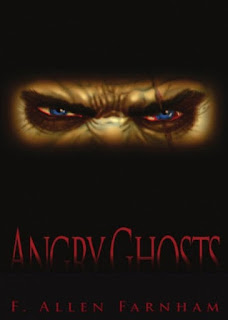
Review: Angry Ghosts, by F. Allen Farnham

Angry Ghosts book cover by author F. Allen FarnhamAngry Ghosts [US](2009), by F. Allen Farnham, is hard edged military science fiction published by Cadre One Publishing.

The Setup

The eradication of all human life on earth at the hands of powerful aliens makes a remote military outpost the last bastion of humanity. Driven solely by the need to survive and wreak vengeance upon their enemy, a thousand years have passed, giving birth to a highly regimented society that has abandoned all human norms, save one: the protection and preservation of life. Having depleted the natural resources necessary to survival surrounding their secret base, the genetically enhanced humans turn to piracy, stealing what they can from the genocidal aliens, who believe them to be the angry ghosts of a civilization they thought exterminated. The story centers around the missions of three elite operators, a Geek, a Gun, and a Brick.

Angry Ghosts is a straightforward look at the exigencies and consequences of the interaction between deep space survival and military structure. Individuality and emotion are frowned upon, and members of society who do not meet stringent mental and physical criteria are lobotomized, summarily turned into thoughtless workers. This extreme of existence is contrasted, later in the story, with the accidental discovery of a long lost colony ship whose occupants are unaltered humans living a complete existence, replete with all its ‘flaws’.

My Take in Brief

Angry Ghosts is a short, workmanlike, and straightforward debut whose author has clearly given much thought to the richness of human existence. The deeply personal relationship he has with the concept, and its ancillaries, comes across clearly, revealing both candid ambiguity towards and profound respect for the human condition. Equal parts philosophical thought experiment, psychological inquiry, and military sci-fi adventure, Angry Ghosts has a fair amount of memorable moments that are sure to entertain.

For all its intellectual approach, a number of elements ring false throughout the novel, distracting from what is otherwise an uncomplicated and fun read. Many of the ‘scientific’ aspects of Angry Ghosts leave much to the imagination, notably space travel and its attendant time distortion, or lack thereof. The experienced science fiction reader will be offended by meager descriptions and the implicit disconnect between the various scientific disciplines. Additionally, the genetically evolved humans suffer from a surprising knowledge gap that requires a strong helping of ‘suspension of disbelief’ to overcome.

Structurally, the author would have been well advised to meter out his revelations, avoiding awkward knowledge dumps in favor of more incremental and suspenseful insights. That said, the story does entertain, putting forward an interesting narrative and a number of intriguing concepts, which generally overcome the novel’s flaws. For an apparent debut, it is a solid start, and I look forward to seeing how the author improves in further installments.

About the Author

Allen was born in Newport, Rhode Island in 1973. After earning a B.A. in Political Science, he abandoned his plans for law school to work in sales. His journal is a constant companion, and in it he develops the thoughts and impressions which shape his novels. There must be more to life than scraping by, he believes, and there must be something left of the world worth passing on. More than themes in his books, these beliefs guide him in his day to day life. He now lives in Salem, Massachusetts with his cat, Tom, and his dog, Hamlet.

02 October, 2009

Interview: David Gunn


I have been fan of the Death's Head series, hard hitting military science fiction, since its inception. Curious to learn a little about the author, David Gunn, whose pen uses adrenaline instead of ink, I was surprised to find out that he writes incognito. Probably the most relevant source of information on Mr. Gunn, besides his infrequently updated Myspace page, is an insightful interview over at Fantasy Book Critic that I encourage you to read. After plowing through and reviewing Death's Head: Day of the Damned, I put in an interview request and was pleasantly surprised by a positive response.

The main thrust of my questions were aimed at uncovering what it is like to write such intense military science fiction in the first person. Sven, the protagonist of the series, for all his harsh talk is a unique and surprisingly complex character. However, revealing plot from the limited perspective can be a challenge that, apparently, is going to take six more books to finish. I threw a hardball or two, but Mr. Gunn handled them well, channeling a bit of Sven in the process.


Thanks for taking the time to talk to me David, I am a big fan of Sven's. Now tell me, it must be exhaustingly fun channeling a character like Sven all day. How do you take the edge off after all that adrenaline packed writing?

Alcohol helps, cigars, thunder storms. Weird as it sounds all help to relax me. Mostly I walk or rough climb hills. There are a couple I know that take you into the middle of nowhere and let you look at a world that hasn't changed in centuries. I'm entirely at home inside my own skin so can go without human company or contact for long periods of time. The cold also works for me. Preferably extremes of it.

How is the next installment to Death’s Head coming along, given that you already hinted at a general objective for the Aux, setting Jaxx Jr. up as emperor? Is there anything you can share with us at this point in time?

I'm halfway through the fourth novel, which if you've read the third, you'll know begins somewhere very far from Farlight indeed. I reckon it's going to take six more books to bring everyone back to where they should be and unravel what needs unravelling. Since we can only see it through Sven's eyes and process it through his brain, we're going to get a little bit more
information and a little bit more of an understanding of the Commonweatlh of the United Free and the outlying empires with every book.


I know some authors who guide their characters and some who are guided by them, and striking a balance between the two can be a real challenge. Does your protagonist drag you along for the ride when you “channel” him, or do you set some boundaries and then let him loose? Essentially, can you describe for us your relationship with Sven?

Sven has been running around inside my head for years. Literally. He was this weird guy in a black uniform in snow-covered ruins, half starving and barely human. Occasionally, I'd think of him and then close that down and get on with what I needed to be doing at the time. But he was always there. Not so much an alter ego. More a elemental force that wandered in from the frozen wastes. It took getting a fever in Central America and crawling around floors halucinating to get him out of my head and onto a laptop. I wrote the first book in a matter of weeks, on adrenaline and a constant hangover.

He's pretty much in control. Mostly I don't know what's going to happen until it does and then the plot goes off on a new path and I think, Right, follow that... There's minimal planning. Sven's a minimal planning kind of guy.

You crank up the intensity of your narrative by writing in the present tense from Sven’s point of view. In retrospect, do you regret the boundaries the limited perspective has imposed on the overall story arc or are you still happy with your choice?

I like that we see what Sven sees. And I like that not everything Sven sees he understands. It lets me unfold his character and increase the scope of the world with every book. Also, he's a fast learner. He's always had the guts. He just never knew he had the brains. That bit of Sven is based on an old friend, now dead, who never quite got that he was a lot brighter than he knew.

With respect to your last book, Death's Head: Day of the Damned, you broadened the scope of the Death’s Head series, gave us a taste of intergalactic real politik, and colored in a lot of blanks for your readers. Much like Sven’s relationship to chess, we are starting to appreciate the size and complexity of the universe in which the Aux live. How did you decide on the shift away from a tightly focused mission driven narrative towards a broader, more complex story?

I've pretty much given the reasons already. The events of the first book lead to the second book, the events of the second book lead to the third, the critical mass grows each time and the scope widens. We begin the series in a cage in a desert fort, about as locked down as you can get, and end the third book... Well, you know where it ends. What matters is one guy, from a cage in a desert fort, now threatens the greatest civilisation the galaxy has ever known. He might not quite have grasped that yet. But he will.


Smartly dressed, resourceful, and discreet, David Gunn has undertaken assignments in Central America, the Middle East, and Russia (among numerous other places). Coming from a service family, he is happiest when on the move and tends not to stay in one town or city for very long. The author of Death’s Head, Death’s Head: Maximum Offense, and Death's Head: Day of the Damned, Gunn lives in the United Kingdom.

11 September, 2009

Death's Head: Day of the Damned, by David Gunn

" I don't get it. Why didn't he just destroy the planet?"
- Anonymous

Death's Head: Day of the Damned (2009), by David Gunn, much like the previous two installments to the series, is comparable to mainlining adrenaline while driving a car blindfolded. Mr. Gunn, who could not have chosen a better pen name, writes what he knows, and action is the order of the day. While Day of the Damned steers the series in a new direction, the evidence suggests that the wheel might have been yanked a bit too hard.

The Setup

Meet Sven, a one armed super-human with a troubled past whose one and only skill is killing people. After growing up in a garbage heap and being conscripted by the man who killed his adoptive mother/sister, he has a short fuze and thinks violence is the solution to every problem. Lucky for him, it is. What he lacks in brains he makes up for with personality, loyalty, and a super-intelligent symbiont living in his throat. Oh, and let us not forget Sven's sentient sidearm, who only seems happy once the body count starts rising.

Much like the previous installments, the story is a keen mix of political intrigue and intergalactic backstabbing centered around a young woman Sven has taken under his wing. Well, maybe it isn't exactly centered around her, so I'll settle for saying it is tangentially related. The fact is that action takes center stage and needs little encouragement to remain in the spotlight, characters be damned. The only real surprise in this addition to the Deaths' Head series is that no planets were destroyed during attempts to achieve the impossible.

My Take in Brief

I have been a fan of David's from the get-go and am sad to report that Day of the Damned just didn't live up to my expectations. While Sven retains his abrupt, appealing, and enigmatic staccato personality, the rest of the characters just do not have the same depth. To compound matters, the pacing felt off-kilter, again, compared to the previous Death's Head books. The story arc was confused and fairly random - as if David had a hard time deciding in which direction the novel should go. I understand that Sven follows his instincts and that advanced planning isn't his forte - as he himself explains many times throughout the novel - but that doesn't mean the storyline should follow his example.

I read the series not for its revelatory philosophy - which amounts to kill or be killed - but for competent futuristic action and senseless violence. On that count, David delivers admirably and doesn't fail to get your blood pumping. However, the more complex backdrop, Octo V's capital planet, underscores David's less than stellar world building abilities and fails to capture the imagination. That said, the drawbacks of the Day of the Damned won't dissuade faithful readers of the Death's Head series from following Sven's adventures, and I still count myself in that category. If anything, the ending has me wishing the next book was already out - serves me right for starting an unfinished series! Grr(m).

Resources

Is David Gunn a mercenary?! His bio blurb on Del Rey suggests he is:

"Smartly dressed, resourceful, and discreet, David Gunn has undertaken assignments in Central America, the Middle East, and Russia (among numerous other places). Coming from a service family, he is happiest when on the move and tends not to stay in one town or city for very long."

The world wide web reveals little of the enigma that is David Gunn, besides one interview at Fantasy Book Critic. My favorite questions, when asked how the Death's Head series came into being, David replies:

"I was down with a fever and hallucinating in a skuzzy hotel in Central America. There’s a scene in "Death’s Head" where Sven is scraping sh*t off a mattress with a knife and crawling across a floor on his knees to vomit in a lavatory. That was for real. I was out of my head for about five days and somehow Sven came out of the experience."

Even though the interview reveals little about David Gunn, it is blunt, honest, and well worth the read. The only other source of information I found is David's MySpace page, which boasts all of three status updates, chief among which appears to be a nasty brandy induced hangover. Regardless, if you enjoyed the first two installments to the Sven saga, you won't be disappointed by Death's Head: Day of the Damned [US][UK].

22 July, 2009

News: Reverse Engineering the Human Brain

As many of you know, TED is a remarkable online and physical resource for discovering innovations from technology and science to activism and lawmaking. Their speakers and scholars are on the cutting edge, and I can't help but draw parallels between what they present, and visions of the future introduced in science fiction novels.

Henry Markram recently and boldly claimed that the human brain will be reverse engineered within the next ten years. Dr. Markram has been working for the last five years to achieve this in rodents and has made significant discoveries (imagine how happy animal rights groups will be when we no longer need to preform cruel experiments on animals). The ethical considerations of animal testing aside, I could not help but think back to the numerous science fiction books I have read where Artificial Intelligence is born after functionally modeling the human brain in a computer environment, thereby allowing the brain to process and understand information at supercomputer speeds. While Dr. Markram generally avoids this science fictiony subject, he is more than adventurous in speculating on the future applications of this revolutionary technology. Enjoy!

06 June, 2009

Review: Starship Troopers, by Robert Heinlein

     Starship Troopers (1958) is probably Robert Heinlein's most famous and controversial book. Even today, it generates a fair amount of debate, whether it be on Wikipedia or Amazon book reviews. Starship Troopers was written in only a couple of weeks in response to a nuclear testing moratorium. As with The Forever War, by Joe Haldeman, it's message is timeless, layered, and consequently often misinterpreted.

The Setup

      Meet your run of the mill highschooler, Juan Rico, who signs up rather accidentally for the Federal Service (army). "On the bounce", we are introduced to a masterpiece of futuristic military warfare as Juan decimates an alien city wearing powered armor. Then, flashback to boot camp and witness firsthand how the soldier of the future is molded. Part philosophical inquiry and part military science fiction thriller, Starship Troopers centers on Juan's trials and tribulations in the Mobile Infantry.
     Starship Troopers is short and sweet, if at times slightly heavy on the philosophizing, but that is just my personal take. What it ultimately boils down  to is an affirmation of patriotism and civic duty. Mr. Heinlein's world is constructed in such a way that only those who have served a "term of service" are allowed to play a constitutive role in society; in the wake of social fragmentation following a global war on earth, entry into politics is restricted to those who have proven their commitment to the 'greater good' through service. Rich in military, philosophical, and political history, Starship Troopers is an insightful and captivating look at duty, courage, and things that go boom.

My Take

     I would love nothing more than to delve into the philosophical underpinnings of Mr. Heinlein's masterpiece, such as the implicit references to Jean-Jacque Rousseau's Second Discourse on the Origins and Foundations of Inequality Among Men, but I will spare you but for this brief excerpt:

With this view, after laying before his neighbours all the horrors of a situation, which armed them all one against another, which rendered their possessions as burdensome as their wants were intolerable, and in which no one could expect any safety either in poverty or riches, he easily invented specious arguments to bring them over to his purpose. "Let us unite," said he, "to secure the weak from oppression, restrain the ambitious, and secure to every man the possession of what belongs to him: Let us form rules of justice and peace, to which all may be obliged to conform, which shall not except persons, but may in some sort make amends for the caprice of fortune, by submitting alike the powerful and the weak to the observance of mutual duties. In a word, instead of turning our forces against ourselves, let us collect them into a sovereign power, which may govern us by wise laws, may protect and defend all the members of the association, repel common enemies, and maintain a perpetual concord and harmony among us.
If you can't guess how that fits into Starship Troopers, you should be shot, possibly in the foot, but shot nonetheless. 
     That said, I could not have loved this book more had it been written with my tastes in mind. As you can tell from my personal top ten science fiction and fantasy books on the side, I enjoy a preponderance of military violence. In that respect, Mr. Heinlein pioneered the science fiction sub-genre of powered armor with this book, so give credit where credit is due. Given the stature and wide range of opinions on the book, it is difficult to dive into discussions of style and worth without upsetting someone, but I personally found the writing very agreeable; in fact, all of it was very agreeable. If you have not read Starship Troopers, you need to. If you think you don't need to, you are wrong. No self-respecting science fiction enthusiast can still lay claim to the title without having read this book.
     If I had to point out something that I felt was lacking from the book, it would be a certain amount of intrigue and suspense. Rico lets spill a little too much a little too early. However, given the narrative style and idea driven plot, Starship Troopers dispenses with the need for frivolous page turning shenanigans with a healthy does of plain old good literature. All in all an excellent, concise, and memorable must read. This is definitely being added to the top ten list, I jut can't decide if it should be socketed in above The Forever War or not... help!

Ratings and Links

Amazon: 4.25/5
B&N: 4.3/5
My Rating: 4.7/5


Piqued Your Interest?

     This is my book, there are many like it, but this one is mine. No giveaway for this book since I am keeping it, which is fairly rare for me. Get your own copy of Starship Troopers if you know what's good for you. 

21 May, 2009

Review: Woken Furies, by R. K. Morgan

     Woken Furies (2005) is the third installment in the action packed Takeshi Kovacs series by Richard Morgan, and is a clear step up over its predecessors. 

The Setup

     While Woken Furies can easily be read as a standalone, you need to read both Altered Carbon and Broken Angels to truly appreciate the depth of the revelations presented. That said, Woken Furies remains a great read in which Mr. Morgan maturing style and skillful character construction will leave you begging for the next installment. 
     Takeshi Kovacs is back on Harlan's World, his onetime home, waging a campaign of indiscriminate slaughter against the priests who killed his one time love. As per usual, a fairly innocuous fight in a restaurant ends up pushing Kovacs straight into the arms of a woman who is none other than a mythical rebellion leader. This time around, other Envoys are involved and the situation promises to get gory, and Mr Morgan promptly delivers.
     Not only is Kovacs set to collide with other Envoys on his moralistic journey, but a re-sleeved, younger copy of himself is out to get him as well. If that isn't enough, well, wait till you see how the Martian technology Kovacs discovered in Broken Angels is put to use. Cunningly orchestrated, Woken Furies is a battle ground for both seething historic forces and morality. If you enjoyed Altered Carbon or Broken Angel's, I'll bet you a book that you will like Woken Furies even more. 

My Take in Brief

     Woken Furies is a definite improvement over its predecessors, both in terms of style, plot, and philosophy. More than at any other point in the series, Takeshi Kovacs comes off as complex and likable. Previously, Mr. Morgan painted himself into a stylistic corner where he was forced to constantly up the suspense and violence to keep the plot ball rolling. I attribute this to the way the author's characters are constructed; they are the embodiment of an inherent contradiction, of competing interests and themes. Somewhat ironically, these inner conflicts are always resolved through outward acts of violence. In Worken Furies Mr. Morgan discovers, to good effect, that its okay to resolve these conflicts internally.
     Beyond the usual acts of gratuitous violence and suspense driven plot, Woken Furies presents the reader with two substantial developments in the context of the series. These are first a refinement of the overarching Quellist philosophy, and second the promise of future interaction with the mythic lost Martian civilization. In my opinion, Woken Furies sets the foundation for a move from the tight focus of military science fiction towards a more complex and compelling space opera. If Mr. Morgan ever decides to shift away from the tight focus on Takeshi Kovacs, he has surely set up what promises to be an epic continuation to the series.

Highlights
  • Takeshi Kovacs facing off against none other than... himself.
  • A refinement of the socio-political dynamic.
  • Boom, squish, whack, crunch, and kerrrplunk.
Lowlights
  • Falling back on a few of the same literary tricks. 
  • An open ending that promises so much in the next installment.
Your Take

     I am honestly curious to see what people think about the Takeshi Kovacs series as a whole at this point. In my estimation Morgan has really developed as a writer, and I am inclined to wonder if you guys and girls see it that way. I haven't picked up The Steel Remains yet, but I am excited to see what his transition to fantasy looks like.

Ratings and Links

Amazon: 4/5
B&N: 3.75/5
My Rating: 4.25/5

A neat review of Woken Furies over at the Wertzone.

Piqued Your Interest?

Woken Furies, the third installment in the Takeshi Kovacs series, is not to be missed. If you enjoyed Altered Carbon and Broken Angels, then this book is not to book is a must read.

Giveaway

Want this book for free? Done. Just follow these simple giveaway instructions for your chance to win (giveaway runs for five days from the date of posting):

1) E-mail me your name and address with the title of the book as the subject. Snarky comments increase your chances of winning.
2) Sign up for site updates either in RSS or with Friend Connect on the side. This will also let you know about future giveaways; typically 2-3 per week.
3) Think happy thoughts.
4) (OPTIONAL) Share or link to any post on my blog--this earns you brownie points as well as increasing your (if you have made it this far) already significant odds.

15 May, 2009

Curiosities: Random Awesomeness

As per usual, a look at some interesting articles, pics, and curiosities that I stumbled across during the week. Make sure to check out the last one, I was really into it.

A great article featuring Vernor Vinge on the Singularity and why science fiction writers are becoming increasingly hesitant to predict the future. 

Just in case you wanted to fine tune the difference between Military Science Fiction adn Space Opera.

Now this is science, not fiction, at its best: a lockbox made of DNA

Couple of these out there, but I enjoyed this one. A look at the science in Star Trek

Science fiction and fantasy readings for socialists. A look at the top 50 must reads. Can you name ten before looking at the list?

Lastly, I leave you with some amazing, and I mean truly cool fantasy photo manipulations. Make sure to check these out you won't be sorry. I just with the new Wheel of Time book had something this good...

Review: Broken Angels, by R. K. Morgan

     Broken Angels (2003) is the second book by Richard K. Morgan in the Takeshi Kovacs series, a hard bitting military science fiction adventure that, once again, is sure to leave you breathless.

The Setup

     Broken Angles follows on the action packed Altered Carbon, and it can easily be read as a standalone book. In Broken Angels, we once again find Takeshi Kovacs hard at work trying not to get killed. This time around, the action centers on the discovery of an ancient Martian door that may very well lead to the greatest technological and archeological find in human history. The only problem is that Sanction IV is embroiled in a full out war, and both sides want a piece of the find. Cutthroat corporate executive, re-sleeved black ops operatives, and nano-tech gone rogue make the second installment in the Takeshi Kovacs series one not to be missed. If you enjoyed Altered Carbon, then you are going to love Broken Angels.

My Take in Brief

     Takeshi Kovacs is a brilliantly constructed character. I am hooked to the tension created by his Envoy training and his individuality. That said, Broken Angles is definitely more formulaic than Altered Carbon, and seems to lack some of the grit and realism present in its predecessor. That doesn't make it a poor read, quite the contrary in fact. I attribute that mostly to this book not being set on Old Earth, a setting to which the plot and action were central last time, as opposed to this installment where the setting on Sanction IV appears secondary. The fact that most of the action takes place on a beachhead doesn't help matters much.
     That said, I really enjoyed this book, with its earthy realism and extended cast of secondary characters. Mr. Morgan is quite the expert at brining to life new characters in as few words as possible. Sadly, he is also quite the expert at getting them killed in fairly gruesome ways as well. As usual, nothing is quite what it seems in the world of Takeshi Kovacs, so be ready for the plot to kick into overdrive and leave you gasping for breath as you are pressed down into your reading chair.
     Here is a blurb from Mr. Morgan himself:

"A deeper and darker excursion into the Kovacs universe, more detail on the politics of the Protectorate, the Martians and the Archaeologue Guild. A planetary war, a paradigm-shattering discovery and a journey into the inner reaches of Takeshi's trauma-ridden consciousness.

"If there was ultimately something clean at the end of Altered Carbon, Broken Angels offers no such comfort. You're just lucky if you get out alive. Focus called it 'nasty', and they were right."
Highlights
  • Boom, squish, splash, crunch.
  • Awesome pace and tempo.
  • I mean come on, its Takeshi Kovacs!
  • The "paradigm-shattering" discovery. It is really cool, no joke.
  • Angry, and self-evolving nano technology.
Lowlights
  • A certain lack of detail in the setting.
  • Slightly formulaic.
  • Again, slightly deus ex, but much cleaner than last time.
Your Take

     I am really curious to see that people though about Broken Angels. I loved the first book, even though it left me feeling like I just avoided a car accident on the highway, and sincerely enjoyed this one as well. Sadly I bought Market Forces thinking it would be another Takeshi Kovacs novel, only to find out it wasn't---its still pretty decent so far though. So, which did you like better: Broken Angels or Altered Carbon?

Ratings and Links

Amazon: 4/5
B&N: 3.5/5
My Rating: 3.8/5

A great review of Broken Angels by MentatJack.
A spot on interview with Richard Morgan by Clarkesworld Magazine.

Piqued Your Interest?

     I love the Takeshi Kovacs series so far and most definitely plan to pick up the third installment soon, so expect a review of that. In the meantime make sure to pick up Altered Carbon if you haven't already, because you are going to love Broken Angels.

Giveaway

Want this book for free? Done. Just follow these simple giveaway instructions for your chance to win (giveaway runs for five days from the date of posting):

1) E-mail me your name and address with the title of the book as the subject. Snarky comments increase your chances of winning.
2) Sign up for site updates either in RSS or with Friend Connect on the side. This will also let you know about future giveaways; typically 2-3 per week. 
3) Think happy thoughts. 
4) (OPTIONAL) Share or link to any post on my blog--this earns you brownie points as well as increasing your (if you have made it this far) already significant odds. 

Congratulations Jake L. on your free copy of Broken Angels. Let us know what you thought when your done reading.

10 May, 2009

Review: Altered Carbon, by R. K. Morgan

    
Richard K. Morgan, Altered Carbon
Altered Carbon (2002) is Richard K. Morgan's debut novel and begins the Takeshi Kovacs series. It is a high adrenaline dystopian science fiction novel that promises to leave you breathless.

Humanity is flung out among the stars, and instead of traveling from planet to planet, people instantly needlecast their conviousness and memories to a new body, at their destination. Death has been eliminated, through resleeving, if you can afford it, or if someone can afford it for you.
Takeshi Kovacs, once a member of the most elite intergalactic force (the Envoys), is needlecast to Earth to serve as a private investigator in the apparent suicide of an immensely powerful man. Violence, sex, and torture mark Takeshi's adrenaline filled journey to the truth, and what a journey it is. Yet, despite his fierce training and penchant for violence, readers will invariably find themselves hooked to Mr. Kovacs, and will be left demanding more.

Before the end of the prologue I was sold, hook, line, and sinker. Altered Carbon is a brilliant mix of military science fiction, and space opera, eloquently framed in a dystopian future earth. Maybe a bit heavy on the tech talk, Richard Morgan nevertheless manages to weave a monumentally compelling tale that demands to be finished the day it was picked up. This book is so gritty, so in your face that it actually hurts. I'm not even talking about the torture scenes -- just the gratuitous violence sequences are enough to make you clench your teeth and give you a sore jaw.
 It is difficult to shake the impression that you are running away from something just as Takeshi Kovacs is running towards his goal. Regardless, this is a work that will thrill just as much as it will raise important theological and theoretical questions. Regardless of your bent and experience with science fiction, I would call this a must read.

Highlights

  • An action packed adrenaline roller-coaster that leaves you breathless.
  • Compelling characters with realistic motivations.
  • A concise gritty and dystopian vision.
  • AIs, drugs, immortality, and chemically/mechanically enhanced bodies.
  • Great prose that gets you right into the action.

Lowlights
  • The torture scenes can be a bit too intense.
  • A few too many fortuitous encounters and discoveries.
  • A few glossed descriptions of the tech.

Your Take

I understand that this series has a lot of fans and few detractors. It is difficult, maybe impossible not to get sucked into the action and the unforgiving pace. Then again, some of you might have put Altered Carbon down for the simple reason that it was too much. Had you been reading a comfy little fantasy novel prior to this, I can easily understand that impulse.
My one question is whether or not some of the scenes, especially the torture scenes went too far for you -- then again, maybe it was the sex scenes. I know I would be hesitant to recommend this book to anyone under the age of eighteen.

Links

A fun interview with Richard Morgan by Infinity Plus.
A theme based interview on the Failures of Capitalism by io9.
A great in depth review of Altered Carbon by A Dribble of Ink.

Piqued Your Interest?

If you enjoy military science fiction or space opera, this is a must read. I don't doubt that once you have read Altered Carbon you won't be able to stay away from the rest of the Takeshi Kovacs novels.

30 April, 2009

Review: The Confederation Series, by T. Huff

The Confederation series, by Tanya Huff, is a tightly focus collection of military style science fiction. The series is comprised, so far, of four books: Valor's Choice (2000), The Better Part of Valor (2002), The Heart of Valor (2007), and Valor's Trial (2008), which are all published by DAW. Do I detect a common theme?

The Setup

Hard-as-nails hardly comes close to describing Marine Gunnery Sergeant Torin Kerr, the protagonist and focus of the series. In the first installment Kerr and her squad are assigned to a spit and polish diplomatic escort mission to a prospective member of the confederation. Little does the unit know that they are going to be battle tested against thousands of humanoid lizards in their bid to win a new ally against the Others.
The second book in the series, following Kerr's incredible success in winning over the lizards to the confederation, has her and her team assigned to a special recon mission of an alien vessel. Just to spice things up, they are sealed onboard with a squad of Others. Close quarters combat ensues between the two factions, only to discover that the ship itself is the real enemy. Apparently, a vastly powerful and sentient species that can take on the form of, well, anything has decided to take an interest in the confederation as well as the Others.
The last two installments are by far my favorite. From a training mission gone wrong to the escape from a hidden underground prison, the reader is led on a merry, adrenaline filled ride. Turning impossible situations into victory is what Sergeant Kerr does, and does well.

My Take in Brief

I truly enjoyed this series. From its quick pace, to the flawless interactions between radically different species, there is something in here for everyone. The tech aspects of the books are slightly glossed, which might disappoint some of you reading this, but they remain perfectly credible. The focus is fixed, throughout, on social and physical interactions. Coupled with some flawless military lingo you get the impression that your just out of boot-camp and looking for Kerr to save your life at every turn.
Fundamentally, this is a work of military science fiction with sprinkles of space opera. The space opera aspect is most definitely secondary to the action/military genre; it serves to get Kerr to interesting places where stuff goes boom, or squish for that matter. That said, those aspects of the book remain compelling, thanks mostly to an accurate and artful portrayal of the relationship between war and politics. The focus is on the integration of disparate alien cultures into a single unified fighting force.
I do recommend this series because it is a captivating and entertaining read. I think I went through all four books in under two weeks. The style and pace are markedly similar to the military science fiction of David Gunn, which I have recently reviewed. If you like Huff you'll want to check him out as well.

Highlights
  • Realistic military lingo and power relationships.
  • Distinct and fascinating cultural interactions.
  • Captivating, if somewhat drawn out battles.
  • Quick, smooth, and entertaining prose.
  • Acts of desperation.
  • Endearing characters that are nevertheless mortal.
Lowlights
  • Everything that you have to sacrifice in order to get desperately epic battles in a short and fast-paced military science fiction book.
Your Take

I realize I have been focused pretty heavily of late on the military/space opera genre, so I am going to read some epic fantasy after I finish with Altered Carbon. What's your general take on the the Confederation series? Do you even enjoy military science fiction or I am boring the hell out of you?

Ratings & Links

Amazon: 3.25/5
B&N: 4.5/5
My Rating: 3.5/5

Tanya Huff's Live Journal: A couple nice recipes there!
And an exciting interview with Tanya Huff.

Piqued Your Interest?

Make sure to check out the omnibus of the first two novels, A Confederation of Valor, if you are considering the series. From what I understand the extra edits were beneficial and you get two for the price of one!

22 April, 2009

Review: The Forever War, by Joe Haldeman

The Forever War, by Joe Haldeman is a moving tale about war. There is no simpler way to put it. The great science fiction and fantasy books out there always carry a deeper meaning or theme; the better the book the more timeless that theme is.

The Setup

William Mandella is a time traveler and a soldier, suffering the relativistic effects of deployment to cosmically distant battlegrounds against the Taurans, earths only enemy. As he rises through the ranks, thanks mostly to an uncanny knack for survival, the reader is exposed to social and technological metamorphoses back on earth. These changes in turn effect Mandella's unit, the tactics and technology at his disposal, and even his relationship to his only love, herself a conscript in the war. A superhuman helping of grit and realism make this one of the quickest and most enjoyable reads I have ever had the enormous pleasure to consume.

My Take

Mr. Haldeman strikes a cord so deep and timeless that should The Forever War ever be forgotten, we would not recognize the world in which we live. The book springs from the heart of a psyche that has endured the pains of war and seeks to communicate the futility of violence to the world. The prose flows simply and beautifully and captures the essence of what it means to fight, to die, and to suffer the deprivations that war brings.
If all that is a bit too poetic for you, let me just say that a lot of stuff goes boom, again and again, in so many awesome and original ways its hard to count. The great thing about the way the book is structured is that it allows the reader to see the development of technology and social moors as a clear Hegelian clash between thesis and antithesis. Nothing is spared by the progress of millennia, only the War itself.

Your Take

The general consensus is that the Forever War is a timeless work of art, similar to Starship Troopers by Robert A. Heinlein. There are a few detractors however, who find that some of the themes go against their moral grain. I personally loved it and found even the most daring turns to be thought provoking and intellectually stimulating. If you have read it, what is your view?

Ratings & Links

Amazon: 4.5/5
B&N: 4.25/5
My Rating: 4.75/5

Read a great interview with Joe Haldeman.

Piqued Your Interest?

This is, quite simply, not a book to be passed over. If you are a science fiction lover then The Forever War needs to be added to your repertoire. If you are just starting out in the genre, there are few better places to start.